



Community Article
Community articles are authored by SitePoint Premium contributors. Content is screened before publication, and SitePoint reserves the right to moderate or remove articles that violate our guidelines. Views expressed are those of the authors and do not necessarily reflect those of SitePoint.
Building a Local Voice-Controlled Hardware System with Python and Termux
Christian chimeremeze ezenwaPublished inSeptember 29, 2026
·Updated:September 29, 2026
The AI briefing for Developers
Stay up to date with AI tools, model releases, and developer workflows that matter.
Weekly. Free. One click to leave.
SitePoint Premium
Stay Relevant and Grow Your Career in Tech
- Premium Results
- Publish articles on SitePoint
- Daily curated jobs
- Learning Paths
- Discounts to dev tools
7 Day Free Trial. Cancel Anytime.
What I learned while experimenting with voice commands, edge processing, and physical hardware.
I wanted to build something that connects software to the physical world.
Not another chatbot.
Not another web application.
Something where I could speak a command and have software turn that command into an action on real hardware.
That led me to a simple experiment:
Can I use an Android phone running Termux as part of a local voice-controlled hardware system?
The answer has taken me into an interesting combination of Python, speech recognition, edge computing, and hardware control.
The idea
The concept is straightforward.
“Turn the relay on.
The system should transform that sentence into a structured instruction and pass it to a hardware-control layer.
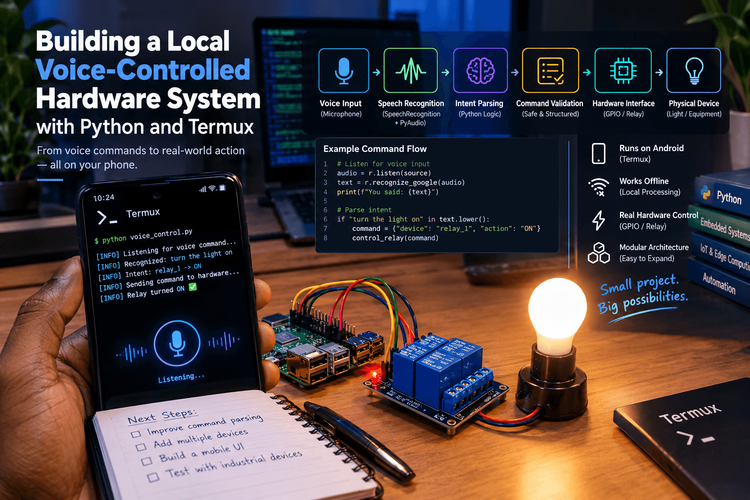
The basic architecture looks like this:
What looks like one simple action is actually several different software problems.
That’s what makes the project interesting.
Why Termux?
I chose Termux because it gives me a practical way to experiment with a Linux-like command-line environment directly on Android.
My phone already has several things an edge system needs:
- A processor
- Memory
- Microphone
- Speaker
- Storage
- Battery
- Network connectivity
Instead of treating the phone only as a user interface, I’m experimenting with it as a computing node.
Python then becomes the glue between the different parts of the system.
It’s to explore how much useful processing can happen locally before a command needs to reach another device.
From natural language to a deterministic command
This is where the project gets more interesting.
Humans communicate with flexible language.
Hardware needs precise instructions.
“Could you please switch the relay on?”
A human understands the intention immediately.
A hardware interface shouldn’t have to understand every possible variation of that sentence.
Instead, the software can convert the recognized speech into a structured representation:
Now the hardware layer has something predictable to work with.
This separation is important.
The voice-processing layer can deal with natural language.
The hardware layer can deal with deterministic commands.
That makes the system easier to reason about and test.
The system needs a safety boundary
One lesson I’m learning is that voice recognition should not automatically equal hardware execution.
Speech recognition can make mistakes.
A command can be ambiguous.
A microphone can pick up background noise.
The user can say something the system doesn’t understand.
So I want the architecture to include a validation stage:
- Speech
- Recognized Text
- Intent
- Validation
- Approved CommandHardwareApp
For example, if the system only supports relay_1 and relay_2, an unknown device shouldn’t simply be passed to the hardware layer.
The command should be rejected or returned for clarification.
That may sound like extra complexity, but once software begins controlling physical devices, predictable behavior becomes much more important.
For my experiments, I’m keeping the hardware side to appropriate low-voltage and isolated setups rather than connecting a prototype directly to hazardous mains electricity.
Why local processing?
One of the reasons I’m interested in this architecture is that it changes the dependency model.
A cloud-based system might look like:
- Device
- Internet
- Cloud Service
- Processing
- Internet
- Device
A local edge system can potentially look more like:
- Device
- Local Processing
- Hardware
- Decision
That doesn’t mean cloud computing is bad.
Cloud services are extremely useful for many applications.
But not every operation needs to leave the device
For some tasks, local processing can reduce dependence on connectivity and keep the processing closer to where the action happens.
That’s the idea I’m exploring.
Where AI fite
I don’t want to add AI simply because the project has the word “AI” in it.
Where does intelligence actually provide value?
doesn’t necessarily require a large language model.
A deterministic parser may be enough.
But more complicated interactions could eventually require a more capable intent layer.
I’m leaving the room. Turn off the equipment I don’t need.”
Now the system needs more context.
Which equipment?
What does “don’t need” mean?
What is currently running?
What rules should apply?
That’s where an intelligent coordination layer could become useful.
The AI shouldn’t replace deterministic hardware control.
It should help interpret higher-level intent and then hand a validated instruction to the control system.
Thinking about the Edge Agent Coordinator
This experiment is also influencing a broader architecture I’m calling the Edge Agent Coordinator EAC).
The idea is to separate (EAC).
The idea is to separate intelligence from device-specific control.
A simplified version could look like:
┌──────────────┐
└──────┬───────┘
┌──────────────┐
└──────┬───────┘
┌──────────────┐
└──────┬───────┘
┌─────────┴─────────┐
The voice interface becomes one input.
Other inputs could eventually include an application, automation rule, sensor event, or another software agent.
The coordinator determines what should happen.
The device interface determines how that action is physically performed.
That separation gives me room to expand the system without rebuilding everything from scratch.
What I’m learning from the project
The most valuable part isn’t getting a relay to switch.
It’s understanding the boundary between software and hardware.
- Language
- Intent
- Validation
- State
- Errors
- Logic
- Signals
- Voltage
- Timing
- Physical devices
- Electrical constraints
The interesting engineering happens in the middle.
A sentence becomes structured data.
Structured data becomes a command.
A command becomes a control signal.
And a control signal produces a physical result.
That’s the bridge I’m interested in building.
What next
I’m still experimenting with the system.
The next steps are around making the pipeline more reliable:
- Better command parsing
- Clear device states
- Error handling
- Local logging
- Hardware feedback
- Multiple device support
- More structured command schemas
Eventually, I’d like to see how far this architecture can go without requiring constant cloud connectivity.
For now, I’m starting with something much smaller:
A phone. Termux. Python. A voice command. And a piece of hardware.
It’s not a finished industrial system.
It’s a learning project.
But sometimes that’s how bigger systems begin.
What would you build?
If you had a phone capable of running local Python code and a small hardware device you could safely control, what would you automate with your voice?
I’d be interested to hear what other developers would build with this kind of edge architecture.
