



Key Takeaways
- Content strategy buy-in often breaks down in translation to non-marketers, even when the strategy is sound.
- Lead with what your stakeholder already measures. How a strategy ties back to organizational cost, risk, or speed means more to them than marketing buzzwords.
- Call attention to problems or poor performance yourself. Clarify any wrong conclusions and present solutions before stakeholders have time to spiral.
- Name what stays the same before you name what changes, so new tactics feel familiar to your audience.
- General recommendations rarely get implemented. Give your audience specific action items in a portable checklist or one-pager.
Most content strategies don’t fail on their merits. They stall out because content strategy buy-in never arrives from the person who funds the work, approves it, or executes part of it. That might be a client-side VP, your own executive team, a sales director, or a legal reviewer who has never opened your editorial calendar.
The data supports the gap. Content Marketing Institute research ranks cross-department collaboration among the top content marketing challenges for 21 percent of B2B marketers.
Content marketers get very good at doing the work but still struggle to convince stakeholders how necessary it is. Those are separate skills, and we need plenty of practice in both.
If you feel like you’re failing to get the right stakeholders on side for your strategy, read on. You’ll learn how to explain content strategy to non-marketers, so they understand the rationale enough to defend it (even when you aren’t in the room).
Teaching Is a Different Skill Than Doing
When stakeholders deny or ignore content strategy, we usually blame the audience. Leadership doesn’t get it. The client won’t listen. Sales ignored the brief (again).
That explanation feels comfortable, but it’s not always the truth. The question is, how well are we explaining ourselves?
The same pattern shows up in every department. A client executive, a product manager, and a compliance reviewer all evaluate your recommendation against a different set of priorities. A decision that looks obvious to a content strategist can read as a cost or a liability to someone who only thinks about content for 20 minutes a month.
Stakeholder education in content marketing is a learnable skill, not a personality trait. Nobody is born knowing how to translate a content audit into CFO speak. You practice, watch what explanations tend to land, and adjust. Here’s what I’ve found works consistently.
Start with the Stakes, Not the Solution
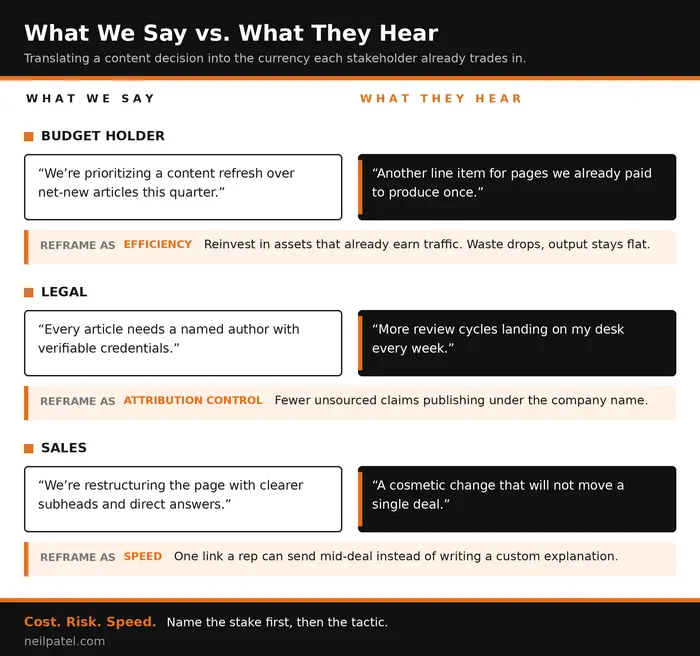
Lead with why the decision matters to the specific person in front of you, in their terms, before you name a framework or tactic. This does more for getting buy-in for content strategy than any deck you build.
Attention follows relevance. Open with a scenario that matches your stakeholder’s priorities, then connect your recommendation to it.
Use this same move across different audiences:
- A budget holder hears a content refresh as spend on something already done. Reframe it as efficiency. You’re reinvesting in assets that already earn traffic instead of funding net-new pages that take months to mature.
- Legal hears a byline requirement on articles as more review work eating up their time. Reframe it as attribution control. Named authors with verifiable credentials reduce the risk of unsourced claims attributed to the company.
- Sales hears a webpage restructure as a cosmetic change. Reframe it as speed. Clear subheads and direct answers let a rep send one link mid-deal instead of writing a custom explanation.
Translate your content strategy into the currency your audience already trades in, then explain the specifics where you need sign-off. Most collaborators tune in if you’re covering cost, risk, or speed.
Beyond buzzwords, root your argument in data they recognize. A content strategist lives in organic sessions, keyword rankings, and time on page. A sales leader watches pipeline contribution and deal velocity; a CFO watches customer acquisition cost and ROI. You don’t have to drop your own metrics, just connect them. Bring the organic sessions that became pipeline; tie your rankings to the deals they influenced. Pull evidence from the dashboard they already open, then draw the line from your metric to theirs.
Defuse the Scariest Interpretation Before They Invent It
Nearly every content strategy shift arrives attached to an alarming headline. A traffic decline. A ranking drop. A platform change nobody controls.
The Pew Research Center tracked 68,879 Google searches and found click-through fell from 15% to 8% when an AI Overview appeared. Read that insight cold in a quarterly review and your client hears one message: our investment is evaporating.
Speak to those concerns before they raise them. State the numbers plainly, then correct potential wrong conclusions immediately. Something like this works: “organic clicks are getting harder to win on informational queries as search engine trends shift, which is why we’re moving effort toward pages that convert and toward becoming the
Skipping an uncomfortable number doesn’t make it disappear. Your audience fills in the blank themselves, usually with something worse than reality, and you find out during Q&A after you’ve lost the floor.
Naming the fear yourself also reads as honesty rather than spin. You’re reassuring stakeholders you already see the problem they’re worried about, and you brought a plan for it.
Anchor New Ideas to What They Already Know
Two techniques work together here to educate stakeholders. First, translate jargon honestly.
Digital marketers have a terminology problem, and pretending otherwise costs you credibility with collaborators outside our industry. Answer engine optimization (AEO) and generative engine optimization (GEO) describe heavily overlapping ideas, and many vendors define them differently. Clarify the terms you’re using rather than posturing.
Skipping this step carries a measurable cost. A survey of 1,000 US workers found that 43 percent believe corporate jargon alienates employees who do not understand it, and a phrase as familiar as “content is king” left 13 percent unsure of its meaning. Assume less shared vocabulary than you think you have.
Second, name what stays the same before you name what changes. Most new content tactics still rest on fundamentals your stakeholders recognize, including clear writing, logical structure, and demonstrated expertise. Optimizing for AI citations relies on many of the same signals that Google’s E-E-A-T guidance has rewarded for years.
Lead with that overlap and your collaborators read the shift as evolution. Lead with everything that’s new and different, and you’ve accidentally told the room that last year’s investment was a wash, which might make them slower to fund the next one.
None of this dumbs the idea down. You’re sequencing it. Familiar first, unfamiliar second, so your content strategy buy-in comes easier.
Turn the Idea into Something They Can Actually Use
Nodding along in a meeting and acting on something afterward are two different outcomes. Content strategists must close the distance between them.
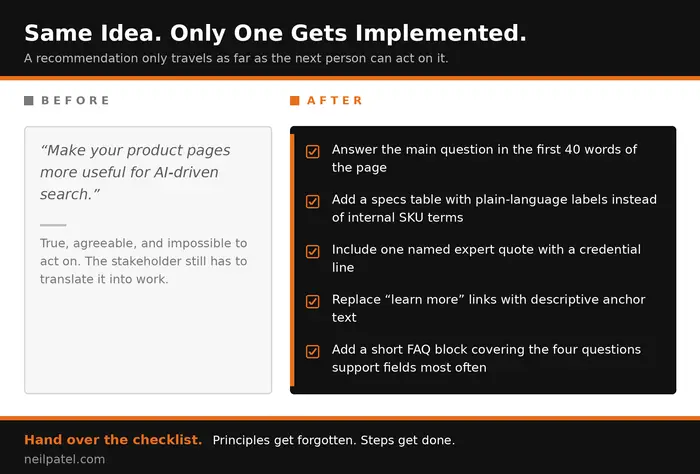
General recommendations rarely get implemented. Checklists do. Short do-and-don’t lists do. Before-and-after comparisons do, because they already connect strategy to action rather than asking your audience to do it alone.
Compare two versions of the same recommendation:
Vague version: Make your product pages more useful for AI-driven search.
- Answer the main question in the first 40 words of the page
- Add a specs table with plain-language labels instead of internal SKU terms
- Include one named expert quote with a credential line
- Replace “learn more” links with descriptive anchor text
- Add a short FAQ block covering the four questions support fields most often.
It’s the same idea, but only one version gets to the finish line.
Tie your content recommendations to your audience’s own material wherever possible. Pull up their actual product page instead of a competitor screenshot. Use their support tickets, their survey data, and last quarter’s best-performing asset. A recommendation built on their evidence lands as relevant in a way that a generic best-practices list never will.
This approach also makes your content marketing training framework easier to repeat. Swap the examples or tactics, but keep the structure.
Always try to hand over something portable. A one-page reference, a short checklist, or a single slide they can forward to the right person. Three weeks later, nobody remembers the strategy session, but they can still open your action items.
Content Strategy as a Conversation, Not a Memo
How you deliver your content strategy to stakeholders matters as much as the material.
Invite questions throughout the session rather than in the final five minutes. Clarify confusion early, and you’re more likely to keep your audience engaged in the strategy. Pause after major points and ask something specific. “Does that match what you’re seeing on your side?” gets better responses than “Any questions?”
Bring in more than one voice when the topic spans disciplines. If the conversation touches content, technical implementation, and paid distribution channels, let the person who owns each area speak to it. You gain accuracy, because nobody has to fake depth of expertise outside their lane. You’re also modeling the cross-functional collaboration you’re asking your audience for.
Read the room as you go. A one-way info dump covers your material. A conversation encourages retention, which is the outcome that matters. Finishing every slide means little if nobody understood the takeaways.
How do you explain content strategy to people who aren’t marketers?
Buy-in follows understanding, so confirm the strategic rationale lands. State the challenge or problem informing your strategy before they imagine a worse one. Skip the marketing acronyms or define them honestly. Anchor new ideas to what stays the same, providing tangible examples and specific next steps.
How do you get stakeholder buy-in for content strategy?
Start with their stakes instead of your framework. Connect content recommendations to organizational cost, risk, or speed before getting into details with tactics. Root the recommendation in data they already track.
What makes content strategy training actually stick?
When content strategy presentations are a two-way conversation, marketers can clarify confusion and keep stakeholders engaged. Follow the conversation with portable materials that capture the action items, and people are far more likely to follow through.
Conclusion
Content strategy buy-in often breaks down in translation, not in the thinking behind it. Open with what your stakeholder already measures. State the problem before they imagine a worse one. Connect the tactics they already trust to the ones you introduce as new. Run your strategy session as a conversation, not a broadcast.
The strongest content marketing programs require more than one team to execute, which means all your collaborators must understand the plan. Learning to explain content strategy to non-marketers is how that happens.
At NP Digital, we treat this as part of the work rather than an afterthought. A content strategy nobody can defend internally rarely gets funded twice. To see what that looks like applied to your own program, talk to our team.
