



Community Article
Community articles are authored by SitePoint Premium contributors. Content is screened before publication, and SitePoint reserves the right to moderate or remove articles that violate our guidelines. Views expressed are those of the authors and do not necessarily reflect those of SitePoint.
How to Improve Email Deliverability Rates
Published inEmail·Email Marketing·
November 10, 2026
·Updated:November 11, 2026
The AI briefing for Developers
Stay up to date with AI tools, model releases, and developer workflows that matter.
Weekly. Free. One click to leave.
SitePoint Premium
Stay Relevant and Grow Your Career in Tech
- Premium Results
- Publish articles on SitePoint
- Daily curated jobs
- Learning Paths
- Discounts to dev tools
7 Day Free Trial. Cancel Anytime.
You wrote a good email. You hit send. Then half your list never saw it, because it went straight to spam.
That is adeliverability problem, and it costs more than most teams think. Every email that misses the inbox is a lead you paid for and never reached.
The good part is that deliverability is not luck. Mailbox providers like Gmail, Yahoo and Outlook judge you on a short list of things: who you are, who you send to, and how people react. Fix those and your inbox placement goes up.
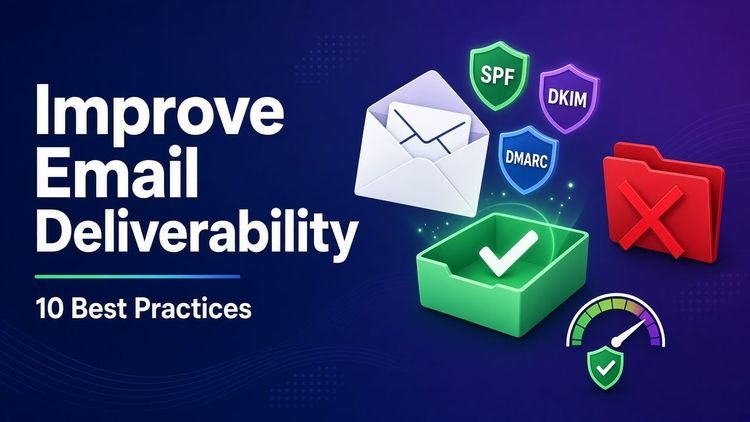
This guide covers 10 email deliverability best practices in the order you should fix them, starting with SPF and ending with sender reputation.
What is email deliverability?
Email deliverability is the share of your emails that land in the inbox instead of the spam folder or nowhere at all.
People often mix it up with delivery rate. They are not the same thing.
- Delivery rate tells you the receiving server accepted the email. It did not bounce.
- Deliverability tells you where the email ended up after that: inbox, promotions tab or spam.
You can have a 99% delivery rate and still have most of your emails sitting in spam. That is why your email tool can say “delivered” while your open rate keeps dropping.
Why it matters more now
The big mailbox providers stopped treating authentication as optional.
Since February 2024, Gmail and Yahoo require anyone sending 5,000 or more emails a day to set up SPF, DKIM and DMARC, add one-click unsubscribe, and keep spam complaints under 0.3%. Gmail tightened enforcement in late 2025, and mail that breaks the rules now gets slowed down or rejected.
Microsoft followed on May 5, 2025. If you send more than 5,000 emails a day to Outlook.com, Hotmail or Live addresses, you need all three records in place or your mail goes to junk.
Send less than 5,000 a day? Follow the rules anyway. The same checks decide inbox placement for small senders too, just without the public warning.
1. Set up SPF so servers know who can send for you
SPF (Sender Policy Framework) is a TXT record in your DNS. It lists the servers allowed to send email from your domain.
When your email arrives, the receiving server checks that list. If the sending server is not on it, the email looks suspicious.
A basic SPF record looks like this:
v=spf1 include:_spf.google.com include:sendgrid.net~all- Only one SPF record per domain. Two records cancel each other out. Merge them into one.
- Stay under 10 DNS lookups. Every include counts. Go over 10 and SPF fails, even if the record is correct.
- List every tool that sends for you. Your CRM, help desk, billing system and newsletter tool all need to be in there.
2. Sign your emails with DKIM
DKIM (DomainKeys Identified Mail) adds a digital signature to each email. The receiving server uses a public key in your DNS to check two things: the email came from you, and nobody changed it on the way.
Your email provider gives you the DKIM record. You paste it into your DNS and switch signing on.
- Use a 2048-bit key. Older 1024-bit keys are weaker.
- Sign with your own domain, not your provider’s default domain. This is what makes DMARC pass later.
- Turn on DKIM for every tool that sends email, not only your main one.
DKIM also survives forwarding, which SPF does not. If you can only get one of the two perfect, get DKIM right.
3. Publish a DMARC record and tighten it over time
DMARC ties SPF and DKIM together. It tells mailbox providers what to do when an email fails both checks, and it sends you reports on who is sending mail under your domain name.
Start with a monitoring policy:
v=DMARC1; p=none; rua=mailto:dmarc@yourdomain.comp=none means “take no action, just send me reports.” It is the minimum Gmail, Yahoo and Microsoft accept from bulk senders.
Don’t stop there. Read the reports for a few weeks, fix any real sender that is failing, then move up:
- p=none to watch and collect data
- p=quarantine to send failing mail to spam
- p=reject to block failing mail completely
One more thing: DMARC needs alignment. The domain in your From address has to match the domain used in SPF or DKIM. Plenty of senders have all three records and still fail DMARC because their email tool signs with its own domain.
If you’d rather not handle this in-house, you can also hire a B2B cold email marketing agency such as IntentSignal, Martal or Belkins. A good agency will set up the domains, mailboxes, warm-up and SPF, DKIM and DMARC records for you, and keep an eye on deliverability while the campaigns run.
4. Warm up new domains and IPs slowly
A new domain has no history. If it sends 10,000 emails on day one, it looks exactly like a spammer who just bought a domain.
Warm-up means starting small and growing a little each day, so mailbox providers can watch how people react to you.
A simple schedule for a new domain:
| Week | Emails per day |
| 1 | 20 to 50 |
| 2 | 100 to 200 |
| 3 | 500 |
| 4 | 1,000 and up, doubling weekly if numbers stay healthy |
Send to your most active contacts first. Their opens and replies are what build trust early. If bounces or complaints jump, hold at that volume until they settle.
And if you run cold outreach, do it from a separate domain or subdomain. That way a bad campaign can’t hurt the domain your invoices and password resets come from.
5. Clean your list regularly
A bigger list is not a better list. Dead addresses and people who stopped caring pull your numbers down.
- Hard bounces. Take them out right after the first bounce. Never email them again.
- Inactive subscribers. If someone has not opened or clicked in 90 to 180 days, send one re-engagement email. No response? Remove them.
- Role addresses like info@ and admin@. They are shared inboxes and complain more often.
- Typos such as gmial.com. An email verification tool catches these before you send.
Never buy a list. Bought lists are full of spam traps, which are addresses that exist only to catch senders who email people without permission. Hitting a few of them can get your domain blocklisted.
6. Use double opt-in
With double opt-in, a new subscriber gets a confirmation email and has to click a link before they join your list.
Yes, you lose some sign-ups. What you keep is real people with working inboxes who actually want your emails. That means fewer bounces, fewer complaints and better opens from day one.
It also keeps bots and fake addresses out of your forms, which matters a lot if your sign-up form is public.
7. Make unsubscribing easy
This sounds backwards, but it works. If people can’t find the unsubscribe link, they hit “Report spam” instead. An unsubscribe costs you one contact. A spam complaint costs you reputation with every provider.
Gmail and Yahoo require bulk senders to support one-click unsubscribe on marketing emails. That means two headers in your email:
List-Unsubscribe:<https://yourdomain.com/unsubscribe/abc123>List-Unsubscribe-Post:List-Unsubscribe=One-ClickMost email platforms add these for you. Check that yours does.
- Keep a clear unsubscribe link in the email body.
- Process opt-outs within two days. Instantly is better.
- Don’t ask people to log in or explain why they’re leaving.
8. Watch your spam complaint and bounce rates
These two numbers tell you the most about where you stand.
| Metric | Healthy | Danger zone |
| Spam complaint rate | Under 0.1% | 0.3% or higher |
| Hard bounce rate | Under 2% | Above 5% |
The complaint figures come from Gmail’s own rules. The bounce figures are the working limits most email platforms use.
A 0.3% complaint rate is only 3 complaints per 1,000 emails. It does not take much to cross that line.
If complaints are climbing, ask three questions:
- Did these people really sign up for this?
- Are you sending more often than you promised?
- Does the email match what they signed up for?
Most complaint problems come from one of those three, not from the email itself.
Spam filters got smarter. A single word like “free” won’t sink you anymore. Patterns will.
- Subject lines in ALL CAPS or with a row of exclamation marks
- Subject lines that promise something the email doesn’t deliver
- Emails that are one big image with no text
- URL shorteners like bit.ly, which spammers love
- Too many links, or links to domains with a bad history
- Large attachments in marketing emails
- Send from a real name and a real address. Not noreply@.
- Keep a healthy mix of text and images.
- Include a plain-text version.
- Segment your list so people get what they care about.
Replies help a lot. When someone replies, the mailbox provider sees a real conversation. Ask a question in your welcome email and you’ll get some.
10. Monitor your sender reputation
Sender reputation is the score mailbox providers give your domain and IP. Everything above feeds into it. A good score means inbox. A bad one means spam, no matter how good the email is.
You can’t see the exact score, but these free tools get you close:
| Tool | What it shows |
| Google Postmaster Tools | Spam rate, authentication results and compliance status for Gmail |
| Microsoft SNDS | IP reputation and complaint data for Outlook and Hotmail |
| MXToolbox | Blocklist checks and DNS record lookups |
| DMARC reports | Who is sending as your domain and whether they pass |
Check them weekly, and right after any big campaign.
A few habits protect your reputation over time:
- Send on a steady schedule. Sudden spikes in volume look like spam.
- Split your mail streams. Put marketing on one subdomain and transactional email on another, so a weak newsletter doesn’t delay a password reset.
- Act fast on a blocklisting. Fix the cause first, then ask for removal. Asking before you fix it gets you listed again.
If your reputation is already damaged, cut volume, send only to your most active subscribers for a few weeks, and build back up. Recovery usually takes two to six weeks of clean sending.
Email deliverability checklist
- One SPF record, under 10 lookups, listing every sending tool
- DKIM turned on with a 2048-bit key and your own domain
- DMARC published, with a plan to reach quarantine or reject
- New domains and IPs warmed up over three to four weeks
- Hard bounces removed and inactive contacts cleaned out
- Double opt-in on sign-up forms
- One-click unsubscribe working, opt-outs handled within two days
- Spam complaints under 0.1% and hard bounces under 2%
- Emails sent from a real address, with text, images and links in balance
- Postmaster Tools and SNDS checked every week
Frequently asked questions
What is a good email deliverability rate?
Aim for 95% or higher inbox placement. Below 90% means something needs fixing, usually authentication or list quality.
Why are my emails going to spam?
The common causes are missing or broken SPF, DKIM or DMARC records, a high complaint rate, an old list with lots of dead addresses, or a new domain that sent too much too soon. Check authentication first because it is the fastest to fix.
How long does it take to improve email deliverability?
DNS fixes like SPF and DKIM take effect within a day or two. Reputation is slower. Expect two to six weeks of steady, clean sending before inbox placement recovers.
Do I need SPF, DKIM and DMARC if I send fewer than 5,000 emails a day?
Yes. The 5,000 mark is where Gmail, Yahoo and Microsoft start enforcing openly. Small senders are still judged on the same signals, and Gmail asks every sender for at least SPF or DKIM.
Does a dedicated IP improve deliverability?
Only if you send enough to keep it warm, roughly 100,000 emails a month or more. Below that, a good shared IP from a trusted provider usually performs better.
What is the difference between sender reputation and domain reputation?
Sender reputation covers both your IP address and your domain. Domain reputation is the part tied to your domain name, and it follows you even if you switch email providers. Gmail leans on domain reputation more than IP.
Start with authentication, then fix the list
If you only have an hour this week, spend it on SPF, DKIM and DMARC. Nothing else works until those pass.
After that, clean your list and keep an eye on complaints. Send emails people asked for, to people who still want them, from a domain that proves who it is. Do that for a few weeks and your emails will land in the inbox again.
