

SitePoint SponsorsPublished inSecurity·Business·Productivity·
November 7, 2026
The AI briefing for Developers
Stay up to date with AI tools, model releases, and developer workflows that matter.
Weekly. Free. One click to leave.
SitePoint Premium
Stay Relevant and Grow Your Career in Tech
- Premium Results
- Publish articles on SitePoint
- Daily curated jobs
- Learning Paths
- Discounts to dev tools
7 Day Free Trial. Cancel Anytime.
Think about what’s sitting in your inbox and Drive right now. Client contracts and invoices. Project specs under NDA. Staging credentials a client emailed you. That API key or password you meant to delete.
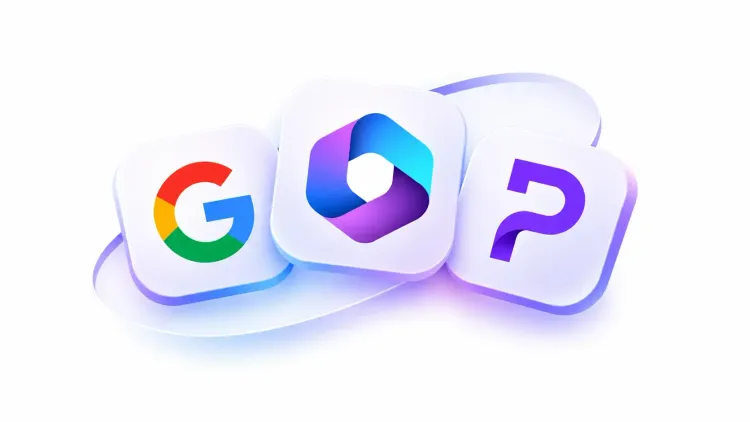
For most developers and freelancers, all of it lives in Google Workspace or Microsoft 365. Both are excellent tools, and both encrypt your data in transit and at rest. But in their standard setup, the provider holds the encryption keys, which means your provider (and the integrated apps and AI features connected to it) can access what’s inside.
Proton Workspace takes a different approach: the same everyday tools, with encryption designed so that not even Proton can read your data.
Here’s how the three compare, what each does best, and which makes the most sense for how you work.
At a Glance: What Each Suite Includes
| Google Workspace | Microsoft 365 | Proton Workspace | |
|---|---|---|---|
| Business email | Gmail | Outlook | Proton Mail |
| Calendar | Google Calendar | Outlook Calendar | Proton Calendar |
| Cloud storage | Drive | OneDrive | Proton Drive |
| Docs and spreadsheets | Docs, Sheets | Word, Excel | Proton Docs, Sheets |
| Video meetings | Meet | Teams | Proton Meet |
| Password manager | Not included | Not included | Proton Pass |
| Business VPN | Not included | Not included | Proton VPN |
| Who holds the encryption keys (default setup) | Microsoft | You | |
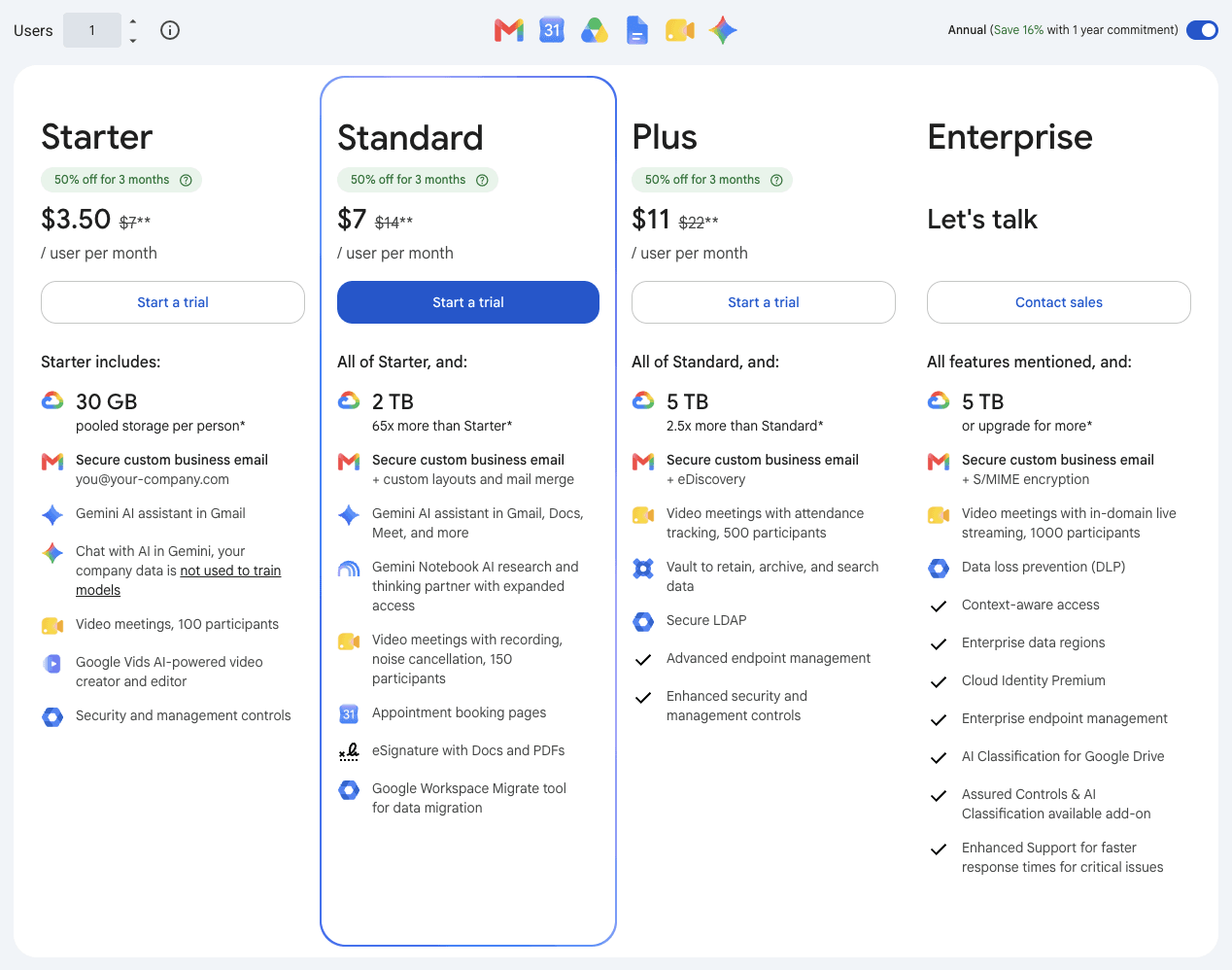
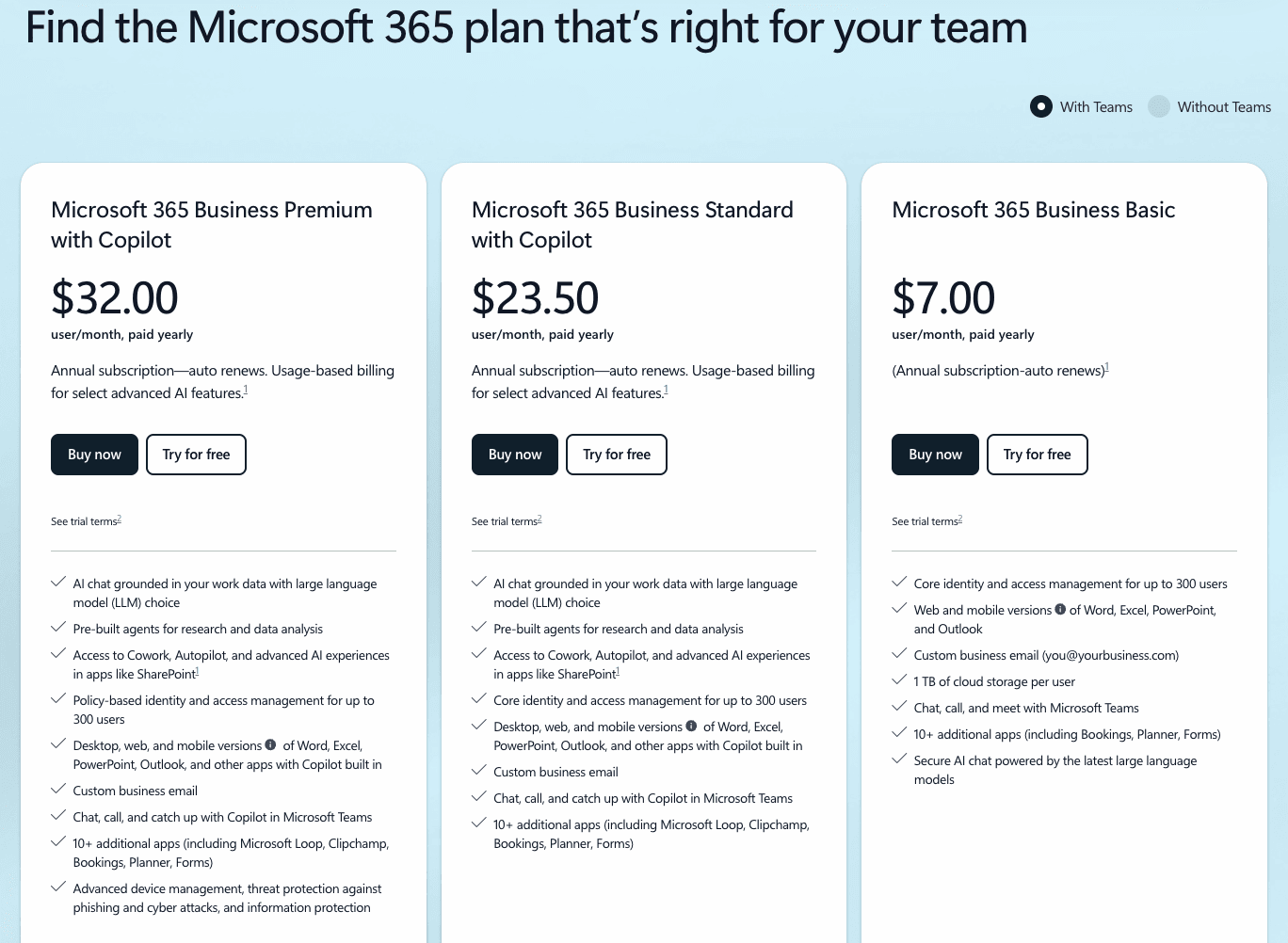
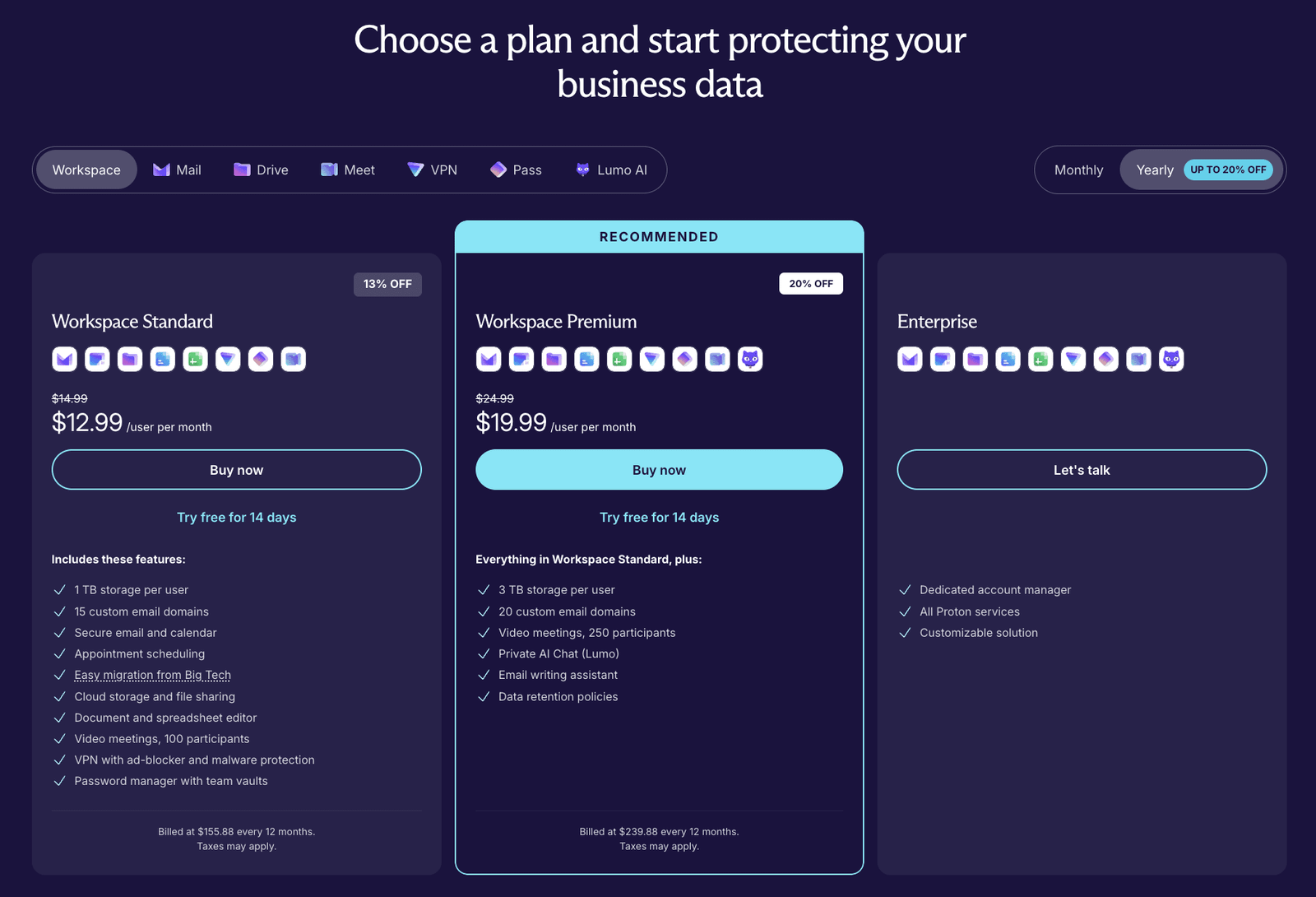
| Business Standard price | $14/user/month | $14/user/month | $12.99/user/month |
Google and Microsoft are built around ecosystem integration. Proton is built around keeping your data yours, without sacrificing productivity tools.
Google Workspace: The Collaboration Standard
Google Workspace is the go-to suite for startups, agencies and freelancers, and for good reason. Gmail, Drive, Docs, Sheets, Calendar and Meet work together seamlessly, and several people can edit the same file in real time without emailing versions back and forth.
- Real-time collaboration in Docs and Sheets
- A huge integration ecosystem, from project management tools to CI/CD notifications
- Browser-first workflows that suit remote and distributed teams
- Gemini AI built into the core apps
Google encrypts data at rest and in transit, and offers client-side encryption on eligible editions. But that extra layer requires higher-tier plans and configuration, so in the default experience Google holds the keys. A password manager and VPN aren’t part of the suite.
Best for: Teams whose top priorities are real-time collaboration and third-party integrations.
Microsoft 365: The Office Standard
If your work runs on Word, Excel and Outlook, Microsoft 365 needs little introduction. Business Standard includes full desktop apps, and Excel remains the benchmark for heavy spreadsheet work.
- Full desktop Office apps, including Excel and PowerPoint
- Teams for chat, meetings and collaboration in one place
- Extensive identity, device and admin controls for larger organizations
That breadth comes with complexity. Licensing, permissions and device management can eat into time a small team or solo developer would rather spend shipping. And like Google, Microsoft’s everyday productivity experience isn’t built around end-to-end encryption, while Copilot and advanced security features add cost.
Best for: Businesses built on desktop Office apps and established Microsoft workflows.
Proton Workspace: The Privacy Standard
Proton Workspace starts from a different premise. Instead of building a productivity suite and adding privacy features on top, Proton built privacy into the foundation, then delivered the everyday tools around it.
What’s included in Workspace Standard:
- Proton Mail and Calendar: Business email on up to 15 custom domains, plus appointment scheduling
- Proton Drive: 1 TB of encrypted storage per user, with password-protected, expiring share links
- Proton Docs and Sheets: Collaborative documents and spreadsheets
- Proton Meet: Encrypted video meetings for up to 100 participants
- Proton Pass: A password manager with team vaults, secure sharing and hide-my-email aliases
- Proton VPN: Secure connections on up to 10 devices per user, with ad-blocker and malware protection
Everything is managed from one admin console, with one bill.
Who Holds the Keys?
This is the core difference. Proton uses zero-access encryption: your data is encrypted before it reaches Proton’s servers, and Proton never holds the keys. Proton can’t read your data. Not won’t. Can’t.
That has practical consequences:
- A breach at Proton doesn’t expose your content, because attackers can’t decrypt what Proton itself can’t.
- Your data can’t train AI models, including Proton’s own Lumo assistant.
- You don’t have to take it on faith. Proton’s apps are open source and independently audited, so you (or anyone) can inspect the code.
- It’s outside the US CLOUD Act. Proton is headquartered in Switzerland, so it can’t be compelled under US law to hand over data it can’t decrypt anyway.
Why Developers and Freelancers Should Care
- Secrets end up in the wrong places. Credentials, .env files and API keys get shared over email and docs more often than anyone admits. Proton Pass gives you shared vaults instead, and anything that does land in Mail or Drive stays encrypted.
- Client trust is your business. NDAs, proprietary code and client data are exactly what you don’t want readable by a third party. Password-protected emails let you send contracts and credentials to clients securely, even if they don’t use Proton.
- Fewer subscriptions to manage. A password manager and VPN usually mean two more bills. Proton includes both.
- It fits your existing workflow. Proton Mail Bridge connects Outlook, Apple Mail and Thunderbird, and you keep your own domain.
The honest trade-offs: Proton Docs and Sheets cover core editing and collaboration, not every advanced Excel feature. There’s no presentation app yet, and the third-party integration ecosystem is smaller than Google’s or Microsoft’s.
Best for: Developers, freelancers, agencies and startups that handle client data, code and credentials, and want privacy and savings in one suite.
How Much Does Each Suite Cost?
US prices for comparable plans with annual billing, excluding taxes:
| Google Workspace Business Standard | Microsoft 365 Business Standard | Proton Workspace Standard | |
|---|---|---|---|
| Price per user/month | $14 | $14 (includes Teams) | $12.99 |
| Storage | 2 TB pooled per user | 1 TB per user | 1 TB encrypted per user |
| Video meetings | Up to 150 participants | Teams | Up to 100 participants |
| Desktop Office apps | No | Yes | No |
| Password manager | Not included | Not included | Included |
| Business VPN | Not included | Not included | Included |
| Provider can read your data | Yes, by default | Yes, by default | No |
The headline prices are close. The real cost isn’t:
- Google’s advanced security features require Business Plus at $22/user/month.
- Microsoft’s full Copilot adds $30/user/month, taking a seat to $44. For a 25-person team, that’s an extra $9,000 a year.
- A password manager and VPN are separate subscriptions with either suite. Proton includes both.
Proton Workspace covers business email, 1 TB of encrypted storage, docs, sheets, video calls, a password manager and a VPN. That’s one bill instead of three.
Need more? Workspace Premium and adds 3 TB of storage per user, 20 custom domains, meetings for up to 250 participants, Lumo private AI and email data retention policies for only $7 more per month. Both plans include a 14-day free trial, and annual plans are currently up to 20% off.
Which Suite Should You Choose?
Choose Google Workspace if your team lives in real-time collaboration and relies heavily on Google’s integration ecosystem.
Choose Microsoft 365 if your work depends on desktop Excel, PowerPoint and established Microsoft workflows.
Choose Proton Workspace if you handle client data, proprietary code or credentials you don’t want readable by your provider or if you want privacy you can verify, with open-
Is Switching to Proton Difficult?
Less than you might expect. Proton’s Easy Switch tool imports email, contacts and calendars from Google Workspace and other providers, and you keep your custom domain, so clients won’t notice a thing. Smaller teams can migrate on their own, and Proton’s business team supports larger moves.
- Audit what you actually use. List your domains, mailboxes, shared calendars, files and any integrations your workflow depends on.
- Set up your organization. Add users and custom domains, and configure permissions in the Proton admin console.
- Migrate with Easy Switch. Import email, contacts and calendars, then plan file transfers to Drive separately.
- Move your credentials into Proton Pass. This is a good moment to pull secrets out of docs, emails and chat threads and into shared vaults.
- Test with a small group first. Confirm everyone can reach their mail, calendars and shared files before switching everyone over.
- Update your DNS records. Point your domain’s MX and related records to Proton, and you’re live.
Moving from Microsoft 365? Check the migration options for each data type rather than assuming every workflow transfers automatically.
Frequently Asked Questions
Is Proton Workspace a good alternative to Google Workspace for developers?
Yes, for developers who prioritize privacy and cost. It covers email, storage, documents, spreadsheets and video calls, adds a password manager and VPN, and costs $12.99/user/month versus $14 for Google Workspace Business Standard.
Can Google Workspace or Microsoft 365 read my email and files?
Can Proton read my email and files?
No. Zero-access encryption means Proton never holds the keys to your stored data. Emails between Proton users are end-to-end encrypted automatically, and you can send password-protected encrypted emails to anyone.
Is Proton open source?
Can I use Proton Mail with my existing email client?
Yes. Proton Mail Bridge connects Outlook, Apple Mail and Thunderbird.
Does Google Workspace or Microsoft 365 use my data to train AI?
It can. If your plan allows Google Workspace or Microsoft 365 to hold the encryption keys, they can access your data and use it to train their integrated AI models.
Does Proton use my data to train AI?
No. Proton can’t read your data, so it can’t use it for AI training.
The Verdict
Google Workspace and Microsoft 365 are mature, capable platforms, and if your work depends on advanced Excel or a deep web of Google integrations, there’s a good case for using them.
But if you’re a freelancer or a developer or running a small team, Proton Workspace is the stronger choice. You get the same core tools for less money, a password manager and VPN you’d otherwise pay for separately, and encryption that keeps client data, code and credentials readable only by you.
You don’t have to take that on faith, either. The code is open
Start your free 14-day Proton Workspace trial, and save up to 20% on annual plans
Sponsored posts are provided by our content partners. Thank you for supporting the partners who make SitePoint possible.
