

Community Article
Community articles are authored by SitePoint Premium contributors. Content is screened before publication, and SitePoint reserves the right to moderate or remove articles that violate our guidelines. Views expressed are those of the authors and do not necessarily reflect those of SitePoint.
Your AI Pipeline Works. But Can You Trust It?
VSVARIJA SINGHPublished inAI·Business·Database·Databases·Data types·Debugging & Deployment·Finance·Frameworks·Management·Miscellaneous·Statistics and Analysis·Technology·Performance & Scaling·Best Practices·
November 19, 2026
·Updated:November 19, 2026
The AI briefing for Developers
Stay up to date with AI tools, model releases, and developer workflows that matter.
Weekly. Free. One click to leave.
SitePoint Premium
Stay Relevant and Grow Your Career in Tech
- Premium Results
- Publish articles on SitePoint
- Daily curated jobs
- Learning Paths
- Discounts to dev tools
7 Day Free Trial. Cancel Anytime.
Introduction: When a Successful Pipeline Produces the Wrong Results
AI is becoming a part of almost everything we do in technology today. Whether it’s detecting fraudulent transactions, assessing credit risk, forecasting demand, or personalizing customer experiences, organizations are increasingly relying on AI to make faster and smarter decisions.
And naturally, when we talk about building AI systems, most of the conversation revolves around model accuracy, performance, and deployment. We spend considerable time making sure our models are trained well, our pipelines run efficiently, and our systems can handle production workloads.
But here’s something we don’t always pay enough attention to: Can we actually trust the data feeding these models?
After all, even the most sophisticated AI model can produce misleading results if the underlying data is incomplete, inconsistent, or incorrectly interpreted. What’s interesting is that these problems don’t always show up as technical failures. Sometimes, everything appears to be working perfectly fine.
Let me give you an example.
Imagine a financial institution that has recently deployed an AI-powered loan risk assessment system. The team has spent months preparing the data, training the model, testing its performance, and finally moving it into production.
The deployment goes smoothly. Data pipelines are running on schedule, predictions are being generated, and all the monitoring dashboards are green.
A few weeks later, however, the business team notices something unusual. The model has started classifying more customers as high risk than expected.
The data science team checks the model configuration. Nothing has changed. The engineering team reviews the pipelines. All jobs have completed successfully. Even the infrastructure looks healthy.
So, where’s the problem?
It turns out that an upstreamm annual gross income to annual net income. The field name remained the same, the data type was still numeric, and none of the existing technical validations detected the change
The pipeline continued running as expected, but the model was now receiving information with a different business meaning.
This brings us to an important point: Just because an AI pipeline runs successfully doesn’t necessarily mean we can trust its output.
Building reliable AI systems requires us to look beyond the model itself. We need to understand where the data originates, how it changes as it moves through different systems, whether it meets quality expectations, and who is responsible when something goes wrong.
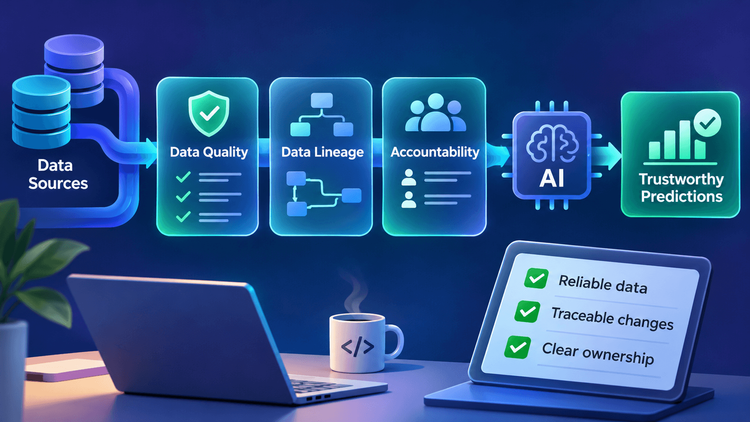
In this article, we’ll explore three important elements of trustworthy AI pipelines (data quality, data lineage, and accountability) and look at how engineering teams can incorporate them into their existing workflows without making the process unnecessarily complicated.
1. Why Traditional Pipeline Monitoring Is Not Enough
Most modern data pipelines come with some form of operational monitoring. Engineering teams track job completion, execution time, system availability, and processing failures.
These metrics are important because they help us understand whether our systems are functioning as expected.
But there’s a limitation.
Operational monitoring primarily tells us whether a pipeline executed successfully. It doesn’t necessarily tell us whether the data being processed is accurate, consistent, or suitable for the model consuming it.
Let’s take a simple example.
Suppose we’re building a loan risk model that uses a customer’s debt-to-income ratio as one of its input features.
The calculation is straightforward:
Debt-to-income ratio = Monthly debt payments / Monthly income
Now imagine that an upstream system starts supplying annual income instead of monthly income.
The calculation still executes successfully. The values are numeric, the transformation doesn’t throw an error, and the model continues generating predictions.
However, the resulting debt-to-income ratio is incorrect because the numerator and denominator represent different time periods.
This is where traditional monitoring falls short.
To build trustworthy AI pipelines, we need to look at different dimensions of system health.
| Monitoring area | What it tells us | Example |
|---|---|---|
| Operational monitoring | Whether the pipeline is running successfully | Job completion, execution time, infrastructure health |
| Data quality monitoring | Whether the data meets defined expectations | Missing values, invalid ranges, inconsistent definitions |
| Model monitoring | Whether the model continues to behave as expected | Prediction drift, feature drift, performance degradation |
| Governance monitoring | Whether data changes and responsibilities are traceable | Lineage tracking, ownership, validation evidence |
These approaches complement each other.
A pipeline can be operationally healthy while processing unreliable data. Similarly, a model can continue producing predictions even when the meaning of an important input field has changed.
For engineering teams, the objective should be to identify these problems as early as possible, ideally before they reach downstream models.
2. Data Quality: The Foundation of Reliable AI
We’ve all heard the phrase “garbage in, garbage out.”
And despite all the progress we’ve made in artificial intelligence, this principle hasn’t changed.
AI models may be capable of processing enormous volumes of data and identifying complex patterns, but they cannot automatically guarantee that the information they’re receiving is correct.
This is where data quality becomes important.
Data quality refers to how well information meets the requirements of its intended use. In AI pipelines, it helps us determine whether incoming data is sufficiently reliable for model training, evaluation, or inference.
Let’s look at four dimensions that are particularly relevant.
Completeness: Are We Missing Important Information?
Imagine we’re developing a loan risk model that relies on customer income, outstanding debt, repayment history, and credit utilization.
What happens if 20% of the incoming records are missing income information?
Should we reject those records? Should we replace missing values using an approved statistical method? Or should we flag them for additional review?
There isn’t one answer that works for every system.
The right approach depends on the model, the business requirements, and the potential consequences of the decision.
What matters is that missing information is handled deliberately.
For example, replacing missing income with zero may allow the pipeline to continue running, but it could significantly distort the model’s predictions.
Validity: Does the Data Make Sense?
Validity checks whether values meet expected formats, ranges, and business rules.
Consider a customer record containing the following information:
- Age: 32
- Annual income: $95,000
- Outstanding loan balance: $18,000
- Credit utilization: 450%
The credit utilization value immediately stands out.
Although credit utilization can exceed 100% in certain circumstances, a value of 450% may warrant investigation.
This highlights an important distinction: Not every unusual value is incorrect, and not every technically valid value is meaningful.
A database may accept any numeric value, but the business may need additional rules to determine whether that value is appropriate for the model.
Engineering teams should distinguish between invalid records, unexpected observations, and legitimate exceptions.
Consistency: Are Different Systems Speaking the Same Language?
This is one of the most common challenges in enterprise data environments.
Imagine two systems providing customer income information.
System A reports annual gross income.
System B reports monthly net income.
Both datasets contain a column called income.
If we combine these datasets without understanding their definitions, we risk introducing inconsistencies into downstream calculations.
The data may look perfectly fine from a technical perspective. The problem is that the same field represents different business concepts.
This is why data definitions, units, and transformation rules are just as important as schema validation.
Timeliness: Is the Data Still Relevant?
Suppose a model predicts a customer’s current financial risk using income information that was last updated 18 months ago.
The data might be accurate, complete, and consistent.
But is it current enough to support the decision?
Not necessarily.
Different AI applications have different freshness requirements.
A real-time fraud detection model may require near-real-time transaction information, while a long-term forecasting model may work with less frequently updated datasets.
The important thing is to define these expectations based on how the data will be used.
How Can Developers Implement Data Quality Controls?
The good news is that improving data quality doesn’t always require sophisticated enterprise tools.
A practical starting point is to define validation rules for the most important input fields.
For example, consider the following conceptual configuration:
dataset: loan_applicationsowner: lending_data_teamchecks:-field: annual_incomerule: greater_thanvalue:0-field: application_idrule: unique-field: application_timestamprule: not_nullon_failure: quarantineThis is an illustrative data quality contract rather than executable configuration for a particular framework.
It defines basic expectations and specifies what should happen when the data fails validation.
Tools such as Great Expectations can help automate these checks. For smaller systems, custom SQL or Python validations may be sufficient.
However, technical validation alone isn’t enough.
Remember our original example where the income field changed from gross to net income?
Both values could easily pass a rule requiring income to be greater than zero.
Detecting that kind of issue requires clear business definitions, communication with upstream systems, and appropriate change management.
In other words, data quality isn’t just about checking values. It’s also about understanding what those values represent.
3. Data Lineage: Understanding the Journey Behind a Prediction
Now let’s assume our loan risk model generates an unexpectedly high risk score for a customer.
The model output is available, but we want to understand what contributed to the prediction.
We start investigating the input data.
The income information came from a customer application system. Outstanding debt came from another database. Both datasets went through several transformations before reaching the feature engineering pipeline.
The final features were then passed to the model.
At this point, a seemingly simple question becomes surprisingly difficult:
Where exactly did the information used for this prediction come from?
This is where data lineage becomes valuable.
Data lineage describes how data originates, moves, and changes across different systems.
For AI pipelines, it helps us understand the journey from raw
A simplified flow might look like this:
Each stage introduces dependencies that can affect downstream results.
Dataset-Level vs. Column-Level Lineage
Data lineage can be captured at different levels of detail.
Dataset-level lineage shows relationships between datasets.
Loan Applications → Cleaned Applications → Model Features
This helps us understand how datasets move through the overall architecture.
However, suppose the model’s debt-to-income ratio suddenly changes.
Dataset-level lineage might tell us which datasets were involved, but it may not provide enough detail to identify the affected field.
That’s where column-level lineage becomes useful.
debt_to_income_ratio = monthly_debt_payment / monthly_income
Column-level lineage can show that the resulting feature depends on two upstream attributes.
If one of those attributes changes, engineers can trace the dependency and investigate the impact.
This is especially valuable in environments where multiple reports, applications, and AI models depend on shared data
How Can Teams Capture Lineage?
Large organizations may use dedicated metadata management and lineage platforms.
However, smaller teams can start by capturing essential metadata during pipeline execution.
- Source dataset identifiers
- Transformation names and versions
- Input and output dataset versions
- Pipeline execution timestamps
- Model versions
- Execution or trace identifiers
OpenLineage provides an open standard for collecting and exchanging lineage metadata across supported systems.
For more detailed prediction-level investigations, teams may also need to retain feature snapshots or inference logs, subject to privacy and retention requirements.
It’s important to understand that lineage doesn’t automatically guarantee data accuracy.
A pipeline can be perfectly documented and still contain incorrect transformation logic.
But when something goes wrong, lineage gives engineering teams a clearer starting point for investigation.
Instead of searching across multiple systems and trying to reconstruct dependencies manually, they can identify where data originated and how it changed along the way.
4. Accountability: Who Owns the Data Behind the Model?
Let’s consider another situation.
An AI model starts producing unexpected results.
The data science team checks the model and finds no issues.
The data engineering team confirms that the pipelines are running successfully.
Yet the problem remains unresolved.
Everyone has completed their individual checks, but nobody has identified who should coordinate the investigation.
This is where accountability becomes important.
AI pipelines often involve multiple teams responsible for different stages of the data lifecycle. Without clearly defined ownership, even relatively simple issues can take longer to resolve.
A practical accountability framework should distinguish between three responsibilities.
Data Ownership
Data owners are responsible for defining the business meaning and expected quality of critical information.
For example, someone needs to determine whether an income field represents gross income, net income, or another financial measure.
These definitions should be documented and communicated to downstream consumers.
Technical Ownership
Data engineering and platform teams typically manage data ingestion, transformations, validation mechanisms, and pipeline operations.
Their responsibilities may include implementing quality checks, monitoring failures, and assessing the technical impact of changes.
However, technical teams shouldn’t be expected to make business-definition decisions without appropriate input.
Model Ownership
Data science and ML engineering teams are responsible for evaluating model behavior, managing model versions, and assessing how changes in input data may affect predictions.
If a critical feature changes, the model team may need to determine whether additional testing, recalibration, or retraining is required.
Connecting Ownership to Incident Response
Defining ownership is useful, but connecting it to an operational process is even more important.
Consider a critical data quality failure during feature generation.
A response process might look like this:
- The pipeline identifies the failed validation rule.
- The affected records are quarantined or processing is paused based on predefined thresholds.
- The responsible engineering team receives an alert.
- The data owner investigates whether the issue reflects a source-data or business-definition change.
- The model team evaluates potential downstream impact.
- Processing resumes after the necessary checks and approvals are completed.
The exact workflow will vary depending on the organization and the risk associated with the application.
The objective is to ensure that technical alerts lead to clear actions.
After all, an alert that nobody owns is just another notification waiting to be ignored.
5. Five Practical Controls for Building Trustworthy AI Pipelines
So far, we’ve discussed why data quality, lineage, and accountability matter.
But how can we bring these concepts into everyday engineering practices?
Here are five controls that teams can introduce without redesigning their entire architecture.
Control 1: Establish Data Contracts
Data contracts define expectations between data producers and consumers.
They can document schemas, field definitions, units, freshness requirements, and compatibility expectations.
For example, rather than specifying only that annual_income is numeric, a contract should clarify whether it represents gross or net income, the currency, and the applicable time period.
This reduces the risk of downstream systems misinterpreting technically valid information.
Control 2: Introduce Quality Gates
Quality gates validate critical data before it progresses through the pipeline.
These checks can be implemented during ingestion, transformation, feature generation, or inference.
For example, a feature engineering process calculating debt-to-income ratios should verify that debt and income values use compatible time periods.
Failure handling should reflect the severity of the issue. Some records may be quarantined, while more serious failures may require stopping the pipeline.
Control 3: Capture Lineage Metadata
Pipeline execution should produce sufficient metadata to identify
Where appropriate, teams should also capture model and feature versions associated with predictions.
This information supports impact analysis, debugging, and investigation when unexpected results occur.
Control 4: Maintain Versioned Evidence
AI systems evolve continuously.
Datasets change, transformation logic is updated, features are modified, and models are retrained.
Versioning helps engineering teams understand which components were active at a particular point in time.
Relevant evidence may include pipeline configurations, dataset snapshots, model versions, validation outcomes, and deployment records.
Retention should be designed around operational requirements, privacy considerations, and applicable policies rather than storing everything indefinitely.
Control 5: Define Ownership and Escalation
Every critical data element or pipeline component should have an identified owner or responsible team.
More importantly, ownership should connect directly to incident management and change approval processes.
If a quality gate fails, the responsible team should receive the alert.
If model performance deteriorates, the investigation should have a clear escalation path.
These controls are most effective when they become part of normal development and deployment practices rather than separate administrative activities.
6. A Practical Starting Point: Govern One Critical Pipeline
Implementing comprehensive governance across an entire data environment can be challenging, particularly for organizations with legacy systems and complex dependencies.
A more effective approach is to begin with one critical AI pipeline.
For example, a team operating a loan risk model could start by identifying the inputs that have the greatest influence on its predictions.
These might include income, outstanding debt, repayment history, and credit utilization.
For each critical input, the team can document five things:
| Question | Expected outcome |
|---|---|
| Where does the data originate? | Identified source system |
| What does the data represent? | Documented business definition |
| How is its quality evaluated? | Defined validation rules |
| How is it transformed? | Traceable transformation logic |
| Who is responsible? | Assigned owner and escalation process |
Once these foundations are established, the team can implement automated checks and gradually extend the approach to additional datasets.
This incremental strategy also makes it easier to demonstrate the value of governance controls.
For instance, teams can track how quickly data-related incidents are detected, how long investigations take, and whether recurring issues are reduced.
The goal isn’t to introduce governance for its own sake.
It’s to improve the reliability, maintainability, and transparency of the systems developers are responsible for operating.
7. Trustworthy AI Goes Beyond Model Explainability
Explainable AI has become an important topic in machine learning.
Techniques such as feature importance analysis and SHAP can help teams understand which inputs influence model predictions.
However, explainability and data trustworthiness address different problems.
Suppose a model explanation identifies debt-to-income ratio as a major contributor to a customer’s high-risk classification.
That explanation may accurately describe the model’s behavior.
But if the debt-to-income ratio was calculated using an incorrectly defined income field, the explanation alone may not reveal the underlying data issue.
This highlights the importance of evaluating AI systems across multiple dimensions.
Model explainability helps us understand how predictions are generated.
Data quality helps establish whether inputs satisfy defined expectations.
Data lineage provides visibility into where information originated and how it was transformed.
Accountability ensures that identified problems can be investigated and addressed.
These capabilities are complementary rather than interchangeable.
None independently guarantees that an AI system is accurate, fair, secure, or compliant. Together, however, they provide a stronger foundation for evaluating and improving system reliability.
Conclusion: Trust Begins Before the Model
As AI systems become more integrated into business processes, engineering teams face increasing expectations around reliability, transparency, and accountability.
Model accuracy and operational performance remain essential, but they represent only part of the overall picture.
A pipeline can execute successfully while processing inconsistent information. A model can generate predictions using features whose definitions have changed. And an explanation can describe a model’s behavior without identifying problems in the underlying data.
Building trustworthy AI therefore requires attention to the entire data lifecycle.
Data quality controls help detect unreliable inputs. Lineage provides visibility into how information moves through systems. Clear ownership ensures that issues can be investigated and resolved.
Importantly, these practices don’t need to begin with large-scale governance programs or expensive technology investments.
Engineering teams can start with a single critical pipeline, identify its most important data elements, establish quality expectations, and introduce basic traceability and accountability mechanisms.
Over time, these practices can become part of standard development and deployment workflows.
The real measure of a trustworthy AI pipeline isn’t simply whether it produces a prediction. It’s whether the organization can understand, validate, and take responsibility for the information behind that prediction.
After all, a green dashboard is reassuring. But it shouldn’t be the only evidence that an AI system is working as intended.
