



How to Detect Breaking API Changes with TypeScript and OpenAPI

SitePoint TeamPublished inAPIs·Programming·JavaScript·
October 3, 2026
·Updated:October 3, 2026
The AI briefing for Developers
Stay up to date with AI tools, model releases, and developer workflows that matter.
Weekly. Free. One click to leave.
SitePoint Premium
Stay Relevant and Grow Your Career in Tech
- Premium Results
- Publish articles on SitePoint
- Daily curated jobs
- Learning Paths
- Discounts to dev tools
7 Day Free Trial. Cancel Anytime.
A backend team renames a field from userName to user_name as part of a routine cleanup. The frontend compiles without a single warning. Tests pass. The pull request merges. Hours later, production users see blank names everywhere because the UI reads a property that no longer exists. This tutorial walks through building a CI pipeline that catches breaking API changes at two distinct layers.
- Commit a baseline OpenAPI spec (
openapi/api.yaml) to your main branch as the single source of truth. - Install oasdiff via Go and openapi-typescript plus TypeScript as dev dependencies in your project.
- Configure a GitHub Actions workflow triggered on pull requests that modify
openapi/orsrc/paths. - Extract the baseline spec from the main branch using
git showin the CI pipeline. - Run
oasdiff breakingto compare the baseline and PR specs, failing the build on breaking changes. - Generate TypeScript types from the updated spec using
npx openapi-typescript. - Compile the frontend with
tsc --noEmitto verify all code references match the regenerated types. - Review CI output to identify both the API-level break (oasdiff report) and the affected frontend code (compiler errors).
Table of Contents
- The Silent Contract Break
- Why Compiled TypeScript Doesn’t Protect You
- Approach 1: Spec-Level Breaking Change Detection with oasdiff
- Approach 2: TypeScript Type Generation with openapi-typescript
- Combining Both Layers in a GitHub Actions Pipeline
- Contract Enforcement Decision Table: oasdiff vs. Zod vs. tRPC
- Extending the Pipeline: Optional Enhancements
- Shift Contract Verification Left
The Silent Contract Break
A backend team renames a field from userName to user_name as part of a routine cleanup. The frontend compiles without a single warning. Tests pass. The pull request merges. Hours later, production users see blank names everywhere because the UI reads a property that no longer exists. This scenario represents a class of bugs that most frontend teams have no automated defense against.
This is contract drift: the growing, invisible gap between what an API actually returns and what the frontend code expects. Detecting breaking API changes with TypeScript and OpenAPI requires more than type annotations. It demands a systematic enforcement checkpoint embedded directly in continuous integration.
Detecting breaking API changes with TypeScript and OpenAPI requires more than type annotations. It demands a systematic enforcement checkpoint embedded directly in continuous integration.
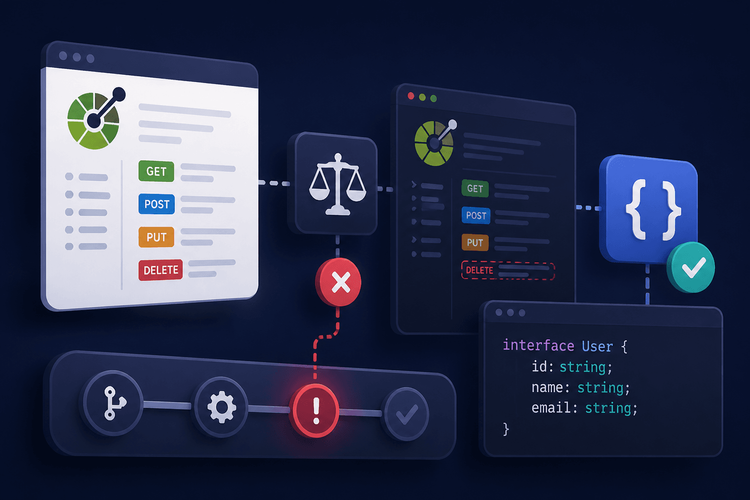
This tutorial walks through building a CI pipeline that catches breaking API changes at two distinct layers. The first layer uses oasdiff, a CLI tool for diffing OpenAPI specifications, to surface structural changes before code is even touched. The second layer uses openapi-typescript to generate TypeScript types from the spec, then runs tsc to verify the frontend still compiles against the new contract. The full stack includes OpenAPI 3.0.3, oasdiff, openapi-typescript, and GitHub Actions, with a decision table comparing this approach against Zod runtime validation and tRPC.
Prerequisites
Before following along, ensure your repository contains:
- Install Go 1.26+ (required for
go installof the current oasdiff release). - Install Node.js 22.x (an active LTS line) and its bundled npm.
- Commit a
package.jsonwithopenapi-typescript@7andtypescriptasdevDependencies, along with apackage-lock.json(runnpm installand commit the lockfile). - Add a
tsconfig.jsonto the repository root (see example below). - Commit an
openapi/api.yamlbaseline spec to themainbranch. - Enable GitHub Actions on the repository.
{"name":"api-contract-check","private":true,"devDependencies":{"openapi-typescript":"7.13.0","typescript":"5.9.3"}}{"compilerOptions":{"strict":true,"target":"ES2022","module":"ES2022","moduleResolution":"bundler","noEmit":true},"include":["src"]}Why Compiled TypeScript Doesn’t Protect You
The False Safety of any and Hand-Written Types
Hand-maintained TypeScript interfaces have no binding relationship to the actual API contract. They represent a developer’s understanding of the response shape at a moment in time. When the backend changes, the interface stays frozen.
interfaceUserResponse{id:number;userName:string;email:string;}asyncfunctiongetUser(id:number):Promise<UserResponse>{const res =awaitfetch(`/api/users/${id}`);return res.json();}const user =awaitgetUser(1);console.log(user.userName);The fetch call’s res.json() returns Promise<any>; TypeScript accepts an unsafe cast to UserResponse without verification. When the backend renames userName to user_name, no compiler error fires. The value of user.userName silently becomes undefined, and the bug ships.
Where the Feedback Loop Breaks
The typical failure path follows a predictable sequence: the API spec changes, the backend team sends no notification to the frontend team, CI stays green because the hand-written types still match themselves, and production breaks. The missing piece is a contract enforcement checkpoint in CI, something that detects when the spec and the frontend’s assumptions diverge before the code ever reaches a deployed environment.
Approach 1: Spec-Level Breaking Change Detection with oasdiff
What oasdiff Does
oasdiff is a CLI tool that compares two OpenAPI spec revisions and classifies every difference as breaking or non-breaking. It detects removed endpoints, changed required fields, response schema changes, modified status codes, added required request parameters, and changed property types. It does one thing: answer whether an API change will break existing consumers.
Setting Up oasdiff Locally
Install oasdiffstallation method, which the CI workflow later in this article also uses. The Docker image works for local use but does not appear in the GitHub Actions workflow shown here
go install github.com/oasdiff/oasdiff@v1.33.0exportPATH="$HOME/go/bin:$PATH"docker pull tufin/oasdiffoasdiff breaking api-v1.yaml api-v2.yamlCreating a Baseline and Revised Spec for Testing
To demonstrate detection, two minimal OpenAPI specs are needed. The first represents the current contract:
openapi:"3.0.3"info:title: User Serviceversion:"1.0.0"paths:/users/{id}:get:operationId: getUserparameters:-name: idin: pathrequired:trueschema:type: integerresponses:"200":description: A single usercontent:application/json:schema:$ref:"#/components/schemas/UserResponse"components:schemas:UserResponse:type: objectrequired:[id, userName, email]properties:id:type: integeruserName:type: stringemail:type: stringThe revised spec renames userName to user_name:
openapi:"3.0.3"info:title: User Serviceversion:"2.0.0"paths:/users/{id}:get:operationId: getUserparameters:-name: idin: pathrequired:trueschema:type: integerresponses:"200":description: A single usercontent:application/json:schema:$ref:"#/components/schemas/UserResponse"components:schemas:UserResponse:type: objectrequired:[id, user_name, email]properties:id:type: integeruser_name:type: stringemail:type: stringReading the oasdiff Output
Running oasdiff breaking api-v1.yaml api-v2.yaml produces output that identifies the severity level (error), the affected path (/users/{id}), and a description of the breaking change (the required response property userName was removed). By default oasdiff breaking only reports what it finds and exits with code 0. Add --fail-on ERR and it exits with code 1 when it finds error-level breaking changes. That exit code makes it usable as a CI gate without any wrapper scripting.
Approach 2: TypeScript Type Generation with openapi-typescript
Generating Types from the OpenAPI Spec
openapi-typescript reads an OpenAPI spec and emits TypeScript type definitions that mirror the contract exactly. Unlike hand-written interfaces, these types derive directly from the spec, so they reflect every field, every required marker, and every type constraint the API declares.
Note: The generated output format varies between major versions of openapi-typescript. The examples below assume openapi-typescript v7.x. Pin the version explicitly in package.json (e.g., "openapi-typescript": "7.13.0") to ensure consistent output across environments. Running npx openapi-typescript without a locally installed version may resolve a different major version, producing incompatible type shapes.
npx openapi-typescript api-v2.yaml -o src/api-types.tsThe generated output uses a namespace structure with paths, operations, and components sections. The exact shape depends on your openapi-typescript version, but for v7.x the components schema types are accessible under components["schemas"]. After running the command above, inspect src/api-types.ts to confirm the generated structure. The key detail is that userName is gone. The type now only contains user_name, exactly matching the revised spec.
A simplified representation of the relevant generated types:
exportinterfacecomponents{schemas:{UserResponse:{id:number;user_name:string;email:string;};};}Important: Run npx openapi-typescript against your own spec and review the actual generated file. The snippet above is a simplified illustration of the schema portion. Your generated file will contain additional exported types for paths, webhooks, operations, and other OpenAPI constructs.
Wiring Generated Types into Frontend Code
When the frontend imports and uses the generated types, tsc catches mismatches at compile time. The example below also includes a runtime type guard to validate the response shape, since fetch returns untyped data and a type assertion alone provides no runtime safety:
importtype{ components }from"./api-types";typeUserResponse= components["schemas"]["UserResponse"];functionisUserResponse(value:unknown): value is UserResponse {if(typeof value !=="object"|| value ===null)returnfalse;const v = value as Record<string,unknown>;return(typeof v["id"]==="number"&&typeof v["user_name"]==="string"&&typeof v["email"]==="string");}asyncfunctiongetUser(id:number):Promise<UserResponse>{const res =awaitfetch(`/api/users/${id}`);if(!res.ok){thrownewError(`HTTP${res.status}fetching user${id}`);}const body:unknown=await res.json();if(!isUserResponse(body)){thrownewError(`Unexpected response shape for user${id}`);}return body;}asyncfunctiondisplayUser(id:number):Promise<void>{const user =awaitgetUser(id);console.log(user.user_name);}The compiler surfaces the exact field that changed, pointing the developer to the correct property name. The bug is caught before the code leaves the developer’s machine. The runtime type guard additionally ensures that malformed or unexpected responses throw an explicit error rather than silently propagating undefined values.
Note: The primary error code for a nonexistent property is ts(2339). TypeScript may additionally show ts(2551) (“Did you mean…?”) when it detects a close match. Both indicate the same underlying mismatch.
Why Type Generation Alone Isn’t Enough
Generated types catch drift only if a developer regenerates them and runs tsc. This is an on-demand mechanism. Without spec diffing, reviewers evaluating the upstream change never see the nature of the break: whether it is a removed field, a type change, or a new required parameter. Spec diffing provides the diagnostic; type generation provides the verification. Both layers serve different audiences and failure modes.
Combining Both Layers in a GitHub Actions Pipeline
Pipeline Architecture Overview
The CI flow operates in two stages. Stage one runs oasdiff to compare the incoming spec against the baseline from the main branch. If oasdiff detects breaking changes, the build fails immediately, giving API reviewers a clear signal before any frontend code is evaluated. Stage two depends on stage one passing (or being explicitly overridden). It runs openapi-typescript to regenerate types and then executes tsc --noEmit to validate that the frontend compiles against the new contract.
Both stages matter for distinct reasons. Spec diffing catches API-side regressions that may affect any consumer, not just the TypeScript frontend. Type checking catches frontend-side assumptions, places where the application code references fields or structures that have shifted under the new contract.
Spec diffing catches API-side regressions that may affect any consumer, not just the TypeScript frontend. Type checking catches frontend-side assumptions, places where the application code references fields or structures that have shifted under the new contract.
The Full GitHub Actions Workflow
Prerequisite: Your repository must contain a committed package.json (with openapi-typescript and typescript in devDependencies), a package-lock.json, and a tsconfig.json. See the Prerequisites section at the top of this article for examples.
name: API Contract Checkon:pull_request:paths:-"openapi/**"-"src/**"jobs:spec-diff:name: Spec Breaking Change Detectionruns-on: ubuntu-lateststeps:-name: Checkout PR branchuses: actions/checkout@v7with:fetch-depth:0-name: Checkout baseline spec from mainrun:|git fetch origin mainif ! git show origin/main:openapi/api.yaml > "$RUNNER_TEMP/api-baseline.yaml" 2>/dev/null; thenecho "::error::openapi/api.yaml not found on origin/main. Commit a baseline spec first."exit 1fiif [ ! -s "$RUNNER_TEMP/api-baseline.yaml" ]; thenecho "::error::Baseline spec is empty."exit 1fi-name: Setup Gouses: actions/setup-go@v7with:go-version:"1.26"-name: Install oasdiffrun:|go install github.com/oasdiff/oasdiff@v1.33.0echo "$HOME/go/bin" >> "$GITHUB_PATH"-name: Run breaking change detectionrun: oasdiff breaking --fail-on ERR "$RUNNER_TEMP/api-baseline.yaml" openapi/api.yamltype-check:name: TypeScript Type Verificationruns-on: ubuntu-latestneeds: spec-diffsteps:-name: Checkout PR branchuses: actions/checkout@v7-name: Setup Node.jsuses: actions/setup-node@v7with:node-version:"22.x"-name: Install dependenciesrun: npm ci-name: Generate types from OpenAPI specrun:|npx openapi-typescript openapi/api.yaml -o src/api-types.tsif [ ! -s src/api-types.ts ]; thenecho "::error::Type generation produced no output. Check openapi/api.yaml for errors."exit 1fi-name: Compile TypeScript (no emit)run: npx tsc --project tsconfig.json --noEmitThis workflow triggers on pull requests modifying files in openapi/ or src/. The spec-diff job fetches the baseline spec from the main branch using a full clone (fetch-depth: 0) and compares it against the PR version. The type-check job only runs if spec-diff passes, regenerates types, and validates compilation.
Common Pitfalls
The default actions/checkout uses fetch-depth: 1. Without fetch-depth: 0, the git show origin/main:openapi/api.yaml command may fail if the file was last modified more than one commit ago.
npm ci requires both package.json and package-lock.json. If only package.json exists, run npm install locally first and commit the generated lockfile.
Running tsc --noEmit without a tsconfig.json produces TS18003: No inputs were found. Commit the config shown in the Prerequisites section.
Pin both oasdiff and openapi-typescript to specific versions. Floating versions cause non-deterministic CI behavior and supply-chain risk.
The git show origin/main:openapi/api.yaml command assumes the spec lives at exactly that path on the main branch. Adjust to match your repository layout. Similarly, go install places binaries in $HOME/go/bin, so the workflow must add this directory to $GITHUB_PATH to ensure oasdiff is found in subsequent steps.
Setting moduleResolution: "bundler" in tsconfig.json requires an explicit module field set to "ES2022" or similar. Without it, TypeScript emits TS5110.
Handling Intentional Breaking Changes
Not every breaking change is accidental. For planned migrations, oasdiff supports a --fail-on flag to control which severity level triggers a non-zero exit. Without --fail-on, oasdiff breaking exits 0 even when it reports breaking changes. --fail-on ERR fails the build on error-level changes only. --fail-on WARN lowers the threshold so that warning-level changes fail it too. For example:
oasdiff breaking api-v1.yaml api-v2.yaml --fail-on ERRA practical pattern is to define a PR label convention, such as breaking-api-approved, that the workflow checks before deciding whether to enforce the gate. The openapi-changes tool complements this approach by generating human-readable HTML changelogs from spec diffs for stakeholder review.
Contract Enforcement Decision Table: oasdiff vs. Zod vs. tRPC
Comparison Criteria
The following table compares three approaches across dimensions that affect real-world adoption decisions:
| Criterion | oasdiff + openapi-typescript | Zod Runtime Validation | tRPC |
|---|---|---|---|
| Detection layer | CI (spec diff + compile) | Runtime (per-request) | Compile-time (shared types) |
| Catches breaking changes before deploy | Yes | No (runtime only) | Yes (monorepo only; not across independently deployed services) |
| Works across language boundaries | Yes (any OpenAPI producer) | TypeScript only | TypeScript only, shared repo |
| Requires monorepo / shared codebase | No | No | Yes |
| Runtime performance cost | None | Schema parsing per call | None (RPC overhead) |
| Provides granular diff report | Yes (oasdiff output) | No | No |
| Spec is the single source of truth | Yes | No (code is truth) | No (router is truth) |
When to Add Zod Alongside oasdiff
Zod and spec-level diffing are not mutually exclusive. Zod runtime validation is particularly valuable for external or third-party APIs where the consuming team does not control the spec and cannot trust that it accurately reflects actual responses. For internal services where the spec is versioned in Git and maintained alongside the implementation, oasdiff plus openapi-typescript catches drift before deployment rather than at request time.
When tRPC Is the Better Fit
In full-stack TypeScript monorepos where frontend and backend share a single codebase, tRPC eliminates the need for OpenAPI entirely. The router definition serves as both the contract and the typeld
The trade-off is coupling: tRPC binds transport and types together, while OpenAPI keeps them independent. A spec-based approach allows non-TypeScript consumers, mobile clients, partner integrations, and documentation generators to use the same contract without modification. tRPC’s compile-time guarantees also do not extend across independently deployed services. If the frontend and backend deploy separately, tRPC cannot catch breaking changes between deployment boundaries.
Extending the Pipeline: Optional Enhancements
Automated PR Comments with oasdiff Markdown Output
oasdiff can render its results in formats other than plain text, including markdown for some commands. Run oasdiff breaking –help to see which formats your installed version supports. Piping that output into a PR commentnto what changed without leaving the pull request interface. This is especially useful for teams where API reviewers and frontend developers review different parts of the same PR
Spectral Linting for Spec Quality
Adding Spectral as a pre-diff lint step enforces naming conventions at authoring time. For example, Spectral’s built-in oas3-schema rule validates structural correctness, and a custom rule targeting property naming (for example, one that enforces camelCase) would flag user_name as a linting error when the revised spec is committed. This prevents the inconsistency at its
Schema Registry and Versioned Spec Storage
Storing specs in a dedicated openapi/ directory with semantic versioning provides an audit trail. When a breaking change is intentionally introduced, the version bump serves as documentation, and historical specs remain available for diffing against any prior version.
Shift Contract Verification Left
Hand-written types create an illusion of safety. They satisfy the compiler while leaving the actual API contract unverified. Spec-level diffing combined with generated types creates a real enforcement loop: the pipeline detects, classifies, and validates changes before code reaches production.
Hand-written types create an illusion of safety. They satisfy the compiler while leaving the actual API contract unverified.
The two-layer CI approach described here serves complementary purposes. oasdiff catches what broke at the API level, providing a diagnostic report for API reviewers. openapi-typescript plus tsc catches how that break affects the frontend, giving application developers a precise compiler error pointing to the affected code.
The GitHub Actions workflow above is ready to copy, adapt to any spec location, and run. The tools referenced here are oasdiff, openapi-typescript, and the broader pattern of contract-first development that treats the OpenAPI spec as the singleand verify the output
Sharing our passion for building incredible internet things.
