



It all depends on the wind.
Do home wind turbines actually work? The answer is a very reserved “yes.” With solar energy cruising into record territory, small-scale wind power for residential use tends to get lost in the sun (poor pun intended).There are several caveats, though wind power is not an altogether losing proposition. It really depends on the need and the scale of use. They even make compact turbines for powering RVs, so it also depends on your definition of “home.”
It’s important to note that a 1 kW turbine is a “peak” power measure, not necessarily what you’ll get out of it. The more useful number to look at is annual or monthly energy production, measured in kilowatt-hours. In a carefully chosen position, a 1 kW turbine could feasibly produce 200 kWh per month, or about 2,400 kWh per year. That works out to under a quarter of the average US household’s annual energy consumption.
None of this is to say that wind turbines are weak power producers — it just depends on the wind. If you live in an area with annual wind speeds averaging 14+ mph, this is something worth looking into. If not, or if windy days are sparse or even average, maybe not so much. A 1 kW system is feasible, but it’s best to look at it in terms of supplemental power for an already efficient home.
Placement determines whether it works
A wind turbine for a home practically requires a high average wind speed that’s consistent month-to-month. Homes with lots of trees, surrounded by other homes, behind hills or with large sheds need not apply. Not only do these obstacles block wind, but they also create turbulence, which reduces output and speeds up wear and tear on the turbine. The Department of Energy’s small wind guidance recommends placing the bottom of the rotor at least 30 feet above any obstacle within 300 horizontal feet of the tower.
That recommendation alone tells you all you need to know about placing a wind turbine in a suburban neighborhood. It’ll make for some interesting conversations at the neighbor’s house, and little more. Worse, most local zoning rules limit structures to around 35 feet, and wind turbines often require much more in order to clear nearby trees and rooftops. A rooftop installation option sounds great on paper, but it can transmit vibration and noise directly into your rooftop, a lovely side effect while trying to catch some Zs before work.
If you’re sold on wind power, look beyond your region’s wind map, check local zoning and utility rules and conduct a thorough assessment of your site’s obstacles and average wind direction. It’s also a good idea to get an installer to estimate overall production before spending your hard-earned dough.
A whole-house turbine needs much more capacity
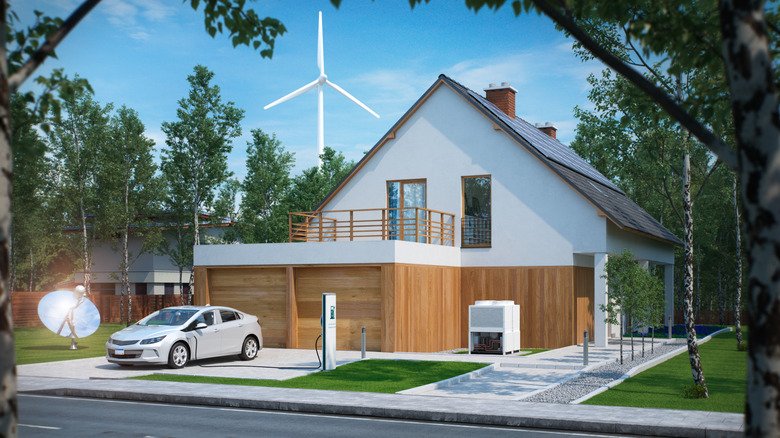
If your home is a small, economical little cabin or a permanently parked RV, a 1kW wind turbine is certainly an option. However, it’s not enough to power a typical US home. The average household uses about 10,500 kWh of electricity per year (around 850 kWh per month), and a residential turbine in the 5 kW to 15 kW range is necessary to put a dent in that power consumption.
Cost is another reason to proceed with a bit of caution. It’ll run the average consumer between $20,000 and $50,000 to toss up a wind turbine. Installing solar panels with the same energy production in mind is roughly $2,500 to $3,500, and that’s before incentives are calculated in.
A grid-connected system typically requires an inverter as well and can offset some utility use when the wind is blowing. Off-grid systems will require batteries and a charge controller to store power. For the majority of suburban dwellers, improving insulation and tossing in some ground- or roof-mounted solar panels will provide more dependable, solid results. If you want to go the wind route, it makes the most sense in open, rural areas that have verified average wind speeds and a place to put your tower.
