



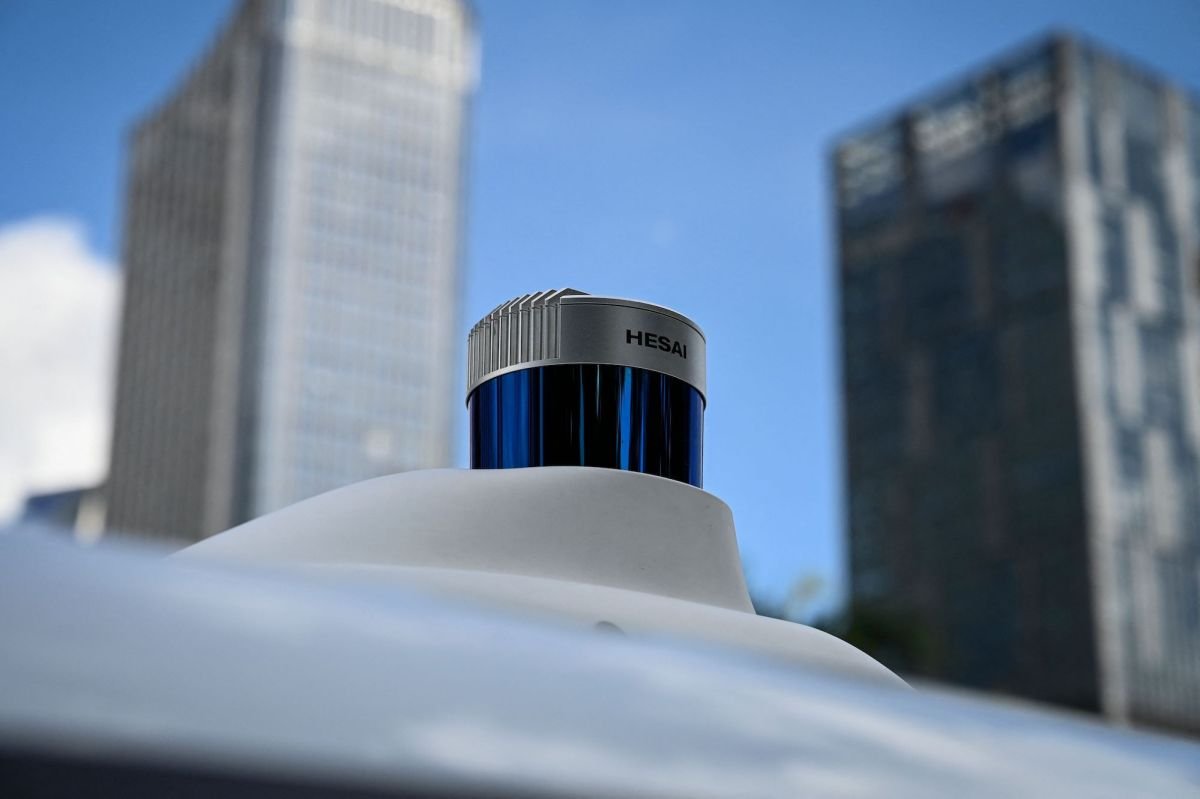
A Department of Energy lab is investigating whether Chinese lidar sensors might pose a security risk if they become widely used on vehicles in the United States, TechCrunch has learned.
The review is being performed by the Idaho National Laboratory, according to two people familiar with the effort, who were granted anonymity to discuss it. The lab has said the research is being funded by a company — or a group of companies — in the electric and autonomous vehicle industries, the
It’s not immediately clear which companies are supporting the review. Representatives for Rir – companies that are reported to be considering Chinese lidar – told TechCrunch they weren’t aware of the review. Nvidia, Zoox, and Aurora didn’t respond to questions about whether they are involved
Idaho National Laboratory declined to comment on the review. A spokesperson told TechCrunch in June, and again in July, that “this isn’t a project that we’re at liberty to discuss with reporters.” China’s leading lidar suppliers, Hesai and RoboSense, did not respond to multiple requests for comment.
Lidar, which stands for light detection and ranging, is a sensor technology that uses laser pulses to measure the distance to nearby objects. It has long been a popular tool for companies working on autonomous vehicles because it offers a high-resolution picture of a self-driving car’s immediate surroundings.
The review is underway as pressure mounts to ban the use of Chinese LiDAR sensors on American roads, with lawmakers crafting multiple bills.
Senator Tammy Baldwin (D-WI), who is spearheading the Securing Infrastructure from Adversaries Act with Senator Ted Budd (R-NC), told TechCrunch in a statement that she’s primarily concerned about Chinese lidar being used for military or industrial espionage.
“As infrastructure becomes more sophisticated, the threat Chinese LiDAR technology poses to American communities and our national security cannot be allowed to go unchecked,” she said. “We need to be doing more to protect Americans and that starts with ensuring taxpayer dollars aren’t being used to purchase technologies that could be used to spy on us.”
Congressman John Moolenaar (R-MI), who is co-sponsoring a different bill aimed at banning the use of Chinese lidar, told CNBClast month that he’s concerned “back doors” could “transmit information back to these Chinese Communist interests.”
Cost over concerns?
There are different layers of risk when it comes to using Chinese lidar CEO and co-founder of Israeli lidar company Innoviz
The first is basic supply chain risk. Keilaf – who said he wasn’t aware of the Idaho National Laboratory review until TechCrunch asked him about it – said that China’s government has deemed lidar to be a strategically important technology.
“So, if, for example, an OEM now builds its entire autonomous driving stack based on a Chinese supply chain, that’s a huge risk down the road,” he said in a recent interview.
The review is more focused on the cybersecurity risks, though – and possibly on giving Chinese-made lidar a clean bill of health in this area, according to the two people familiar with it.
Keilaf described two major cybersecurity risks that Chinese lidar might present. One is that the sensors could be disabled en masse, disrupting vehicles in motion and bricking ones that aren’t.
Researchers have shown in the past that individual lidar sensors can be disabled using lasers. But it’s not obvious how China could cause a widespread disruption of lidar sensors being actively used by robotaxis.
Keilaf also said it’s possible to compress the finely detailed data that lidar sensors collect about their surroundings and transmit that data
“As a person that spent seven years in the in the [Israeli] intelligence force, I can assure you, it’s not very difficult to extract that information. Eventually, the amount of data that the lidar is generating is pretty easily compressed if someone wants to,” he said.
These concerns are relevant now because the cost of lidar has come down dramatically in the last decade.
Lidar has traditionally been far more expensive than other sensors like radar or cameras. Tesla has eschewed it altogether, with CEO Elon Musk calling it a “crutch” and preferring to build his company’s entire autonomy stack around cameras alone.
But Chinese companies like Hesai and RoboSense have quickly scaled and lowered prices, bringing the cost of a product that costas much as $75,000 a decade ago down to just a few hundred bucks in some cases.
American lidar companies have tried to keep pace, but it’s difficult to match China’s economies of scale and lower costs of labor and capital. As a result, U.S. lidar makers have spent the last few years consolidating or, in the case of Luminar, filing for bankruptcy.
This has prompted several automakers and autonomous vehicle companies in the U.S. to consider using Chinese lidar sensors as part of their autonomous vehicle sensor suites.
Rih a lidar sensor integrated into the roof, is reportedly one of those companies
In March, CEO RJ Scaringe told Reuters the company is considering making its own lidar sensors in the U.S. by leveraging Chinese tech, possibly as part of a joint venture,according to the outlet.
“A number of different car manufacturers are thinking about how they could do that either together, or at least through a shared alignment to say, hey, let’s develop production capacity in the United States for this, or at least outside China,” Scaringe said at the time, noting the company was in “active discussions” with lidar firms and that the effort might also include other automakers.
Rians to bring lidar development in-house
U.S. companies are allowed to use Chinese-made lidar, but the future regulatory landscape isn’t clear. The Department of Defense has placed both Hesai and RoboSense on its so-called 1260H list for allegedly supporting the People’s Liberation Army, a designation that restricts their ability to work with the U.S. military.
In 2025, the Commerce Department implemented a rule that prohibits the use of Chinese-made connectivity hardware in U.S. passenger cars, but lidar and other autonomous vehicle sensors are not prohibited.
Lawmakers like Congressman Raja Krishnamoorthi (D-IL), who introduced the bill Moolenaar is co-sponsoring, have spent years warning that widespread adoption could make it possible for China to “gather sensitive data or disrupt our systems.”
For now, concerns about widespread disabling of Chinese lidar remain just that – concerns. But there is at least one incident that offers a glimpse of what such a disruption would look like. In early 2024, customers using Hesai lidar sensors saw their autonomous vehicles suddenly stop working for an entire daybecause the company had not properly accounted for the extra day of the leap year.
