



Community Article
Community articles are authored by SitePoint Premium contributors. Content is screened before publication, and SitePoint reserves the right to moderate or remove articles that violate our guidelines. Views expressed are those of the authors and do not necessarily reflect those of SitePoint.
Predicting Health Plan Member Behavior with Neural Networks: Building a Privacy-First Pipeline for Medicare, Medicaid, and ACA Data
SZShilei ZhangPublished inAI·CMS·
September 11, 2026
·Updated:September 12, 2026
The AI briefing for Developers
Stay up to date with AI tools, model releases, and developer workflows that matter.
Weekly. Free. One click to leave.
SitePoint Premium
Stay Relevant and Grow Your Career in Tech
- Premium Results
- Publish articles on SitePoint
- Daily curated jobs
- Learning Paths
- Discounts to dev tools
7 Day Free Trial. Cancel Anytime.
Introduction
Health plans already know a great deal about what happened yesterday.
Claims show which services members used. Enrollment files show who joined or left a plan. Call-center records show who needed assistance. Digital engagement data shows whether members opened emails, logged into a portal, or interacted with online tools.
The more interesting engineering question is:
Can these signals help us anticipate what a member may need next?
For Medicare, Medicaid, and Affordable Care Act (ACA) populations, predictive analytics could support use cases such as identifying members who may disengage from a health plan, estimating which members are likely to respond to outreach, detecting potential gaps in engagement, or prioritizing populations that may benefit from additional support.
A neural network can help identify relationships across hundreds of variables that may be difficult to capture with traditional reporting.
But healthcare creates an additional requirement that can’t be separated from the machine-learning problem: the data must be collected and used appropriately.
A technically impressive model is not useful if its training pipeline unnecessarily exposes protected health information (PHI), uses data for an unsupported purpose, or gives developers unrestricted access to sensitive records.
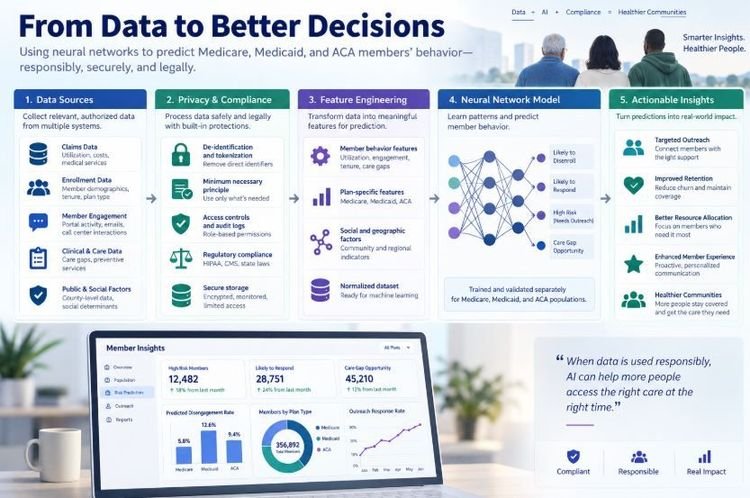
In this tutorial, we’ll design a simplified neural-network pipeline for predicting health plan member behavior while treating privacy, access control, and data minimization as parts of the architecture itself.
Defining the Prediction Problem
Before selecting TensorFlow, PyTorch, or any other machine-learning framework, we need to define exactly what we’re predicting.
“Member behavior” is too broad.
Suppose a health plan wants to predict whether a member is likely to become disengaged over the next 90 days.
0 = member remains engaged1 = member becomes disengaged“Disengaged” would need a precise organizational definition. Depending on the use case, it might represent failure to complete a renewal process, prolonged absence of relevant engagement, or another validated outcome.
The model should not be trained against a vague concept created solely because the data happens to be available.
That distinction matters because predictions ultimately influence what the organization does.
Building the Feature Set
A health plan might have several categories of information available for an appropriately authorized analytics use case.
A simplified feature table could look like this:
member_keyline_of_businessage_bandtenure_monthsclaims_6mpcp_visits_12med_visits_12mportal_logins_90demail_engagement_90dcall_center_contacts_90dprior_engagement_scoretarget_disengaged_90dNotice that we don’t need the member’s name, street address, telephone number, Social Security number, or medical record number to train this particular model.
Instead, the analytics environment can work with an internal member key.
That’s an important design principle:
Don’t give a model sensitive information simply because the organization possesses it.
Under the HIPAA Privacy Rule, covered entities may use and disclose PHI for permitted treatment, payment, and healthcare operations activities, subject to applicable requirements. For payment and healthcare operations, the minimum-necessary standard generally requires reasonable efforts to limit PHI to what is needed for the intended purpose.
The legal basis depends on the specific purpose, entities involved, contracts, and data flow, so production implementations need privacy, compliance, security, and legal review rather than assuming that every predictive use is automatically permissible.
Creating a Privacy-First Data Pipeline
A weak architecture might look like this:
Production Database|vAnalyst Laptop|vPython Notebook|vNeural NetworkThat design creates unnecessary risk.
A better architecture separates identifiable operational information from the machine-learning environment.
Claims ──────────┐Enrollment ──────┤CRM ─────────────┤Portal ──────────┤Call Center ─────┘|v+----------------------+| Controlled Data Layer|+----------------------+|vData Validation|vFeature Engineering|vTokenization /Data Minimization|v+----------------------+| ML Feature Dataset |+----------------------+|vNeural Network|vRisk Probability|vApproved WorkflowThe model receives only the variables required for the approved analytical purpose.
The mapping between member_key and the actual individual remains in a more restricted environment.
Loading the Data
For demonstration, we’ll use a synthetic dataset rather than real member information.
import pandas as pddf = pd.read_csv("synthetic_member_behavior.csv")print(df.head())Before training anything, inspect the dataset.
print(df.info())print(df.isnull().sum())print(df["line_of_business"].value_counts())print(df["target_disengaged_90d"].value_counts())This simple step catches a surprising number of problems.
Healthcare data pipelines commonly contain missing fields, delayed records, duplicated members, inconsistent definitions, and changes in upstream systems. A model will happily learn from bad data unless the pipeline explicitly detects it.
Separating Medicare, Medicaid, and ACA
Medicare, Medicaid, and ACA members should not automatically be treated as interchangeable.
Instead, include line of business explicitly:
lob = pd.get_dummies(df["line_of_business"],prefix="lob",dtype=int)df = pd.concat([df, lob],axis=1)The resulting features might include:
lob_Medicarelob_Medicaidlob_ACAThis allows the model to learn differences associated with each population.
However, including the variable isn’t enough.
Later, we’ll evaluate model performance separately for Medicare, Medicaid, and ACA members. A model that performs well overall but poorly for Medicaid members, for example, should not be considered successful simply because its aggregate accuracy looks good.
Preparing the Features
Let’s select behavioral and utilization variables.
features =["tenure_months","claims_6m","pcp_visits_12m","ed_visits_12m","portal_logins_90d","email_engagement_90d","call_center_contacts_90d","prior_engagement_score","lob_Medicare","lob_Medicaid","lob_ACA"]X = df[features]y = df["target_disengaged_90d"]Next, split the data.
from sklearn.model_selection import train_test_splitX_train, X_test, y_train, y_test = train_test_split(X,y,test_size=0.20,random_state=42,stratify=y)Using stratify=y helps preserve the proportion of positive and negative outcomes across the training and testing datasets.
Standardizing the Data
Our variables use very different scales.
A member might have 36 months of tenure, two emergency department visits, 18 portal logins, and an engagement score of 0.72.
Neural networks generally train more effectively when numerical inputs are standardized.
from sklearn.preprocessing import StandardScalerscaler = StandardScaler()X_train_scaled = scaler.fit_transform(X_train)X_test_scaled = scaler.transform(X_test)Notice that the scaler is fitted only on the training data.
Fitting preprocessing steps on the entire dataset before creating the test set can leak information from the test population into training.
Building the Neural Network
Now we can build a small feed-forward neural network using TensorFlow and Keras.
from tensorflow import kerasfrom tensorflow.keras import layersmodel = keras.Sequential([layers.Input(shape=(X_train_scaled.shape[1],)),layers.Dense(64,activation="relu"),layers.Dropout(0.20),layers.Dense(32,activation="relu"),layers.Dropout(0.20),layers.Dense(1,activation="sigmoid")])The final sigmoid layer produces a probability between zero and one.
Member A → 0.12Member B → 0.47Member C → 0.83Those values should be interpreted as model-estimated probabilities for the defined target—not as facts about the member.
model.compile(optimizer="adam",loss="binary_crossentropy",metrics=[keras.metrics.AUC(name="auc"),keras.metrics.Precision(name="precision"),keras.metrics.Recall(name="recall")])history = model.fit(X_train_scaled,y_train,validation_split=0.20,epochs=30,batch_size=64,verbose=1)The dropout layers help reduce overfitting by randomly disabling a percentage of neurons during training.
Why Accuracy Isn’t Enough
Imagine that only 10% of members meet our disengagement definition.
A useless model that predicts “not disengaged” for everyone would still achieve roughly 90% accuracy.
That’s why healthcare behavioral models need additional evaluation metrics.
predictions = model.predict(X_test_scaled).ravel()from sklearn.metrics import roc_auc_scoreauc = roc_auc_score(y_test,predictions)print("ROC-AUC:", auc)We can also create a classification report using a selected threshold.
from sklearn.metrics import classification_reportpredicted_class =(predictions >=0.50).astype(int)print(classification_report(y_test,predicted_class))Precision tells us how often members classified as high risk actually experienced the outcome.
Recall tells us how much of the target population the model successfully identified.
Which metric matters most depends on the intervention.
Evaluate Each Insurance Population Separately
This is particularly important when building a model across Medicare, Medicaid, and ACA populations.
Attach the predictions back to the test records:
results = X_test.copy()results["actual"]= y_testresults["prediction"]= predictionsresults["line_of_business"]=(df.loc[results.index,"line_of_business"])Now calculate performance by population.
from sklearn.metrics import roc_auc_scorefor lob in["Medicare","Medicaid","ACA"]:subset = results[results["line_of_business"]== lob]if subset["actual"].nunique()<2:continuescore = roc_auc_score(subset["actual"],subset["prediction"])print(lob,round(score,3))Medicare 0.81Medicaid 0.68ACA 0.77An overall AUC of 0.78 could hide the fact that the model performs substantially worse for one population.
That is exactly why aggregate metrics can be dangerous.
Turning Predictions into Action
The output shouldn’t automatically become:
0.83 → Contact MemberA safer design separates prediction from intervention.
Member Data|vNeural Network|vRisk Probability|vBusiness Rules|vApproved Outreach Queue|vHuman / Automated Workflow|vOutcome Measurementdefassign_priority(score):if score >=0.80:return"High"if score >=0.50:return"Medium"return"Low"results["priority"]=(results["prediction"].apply(assign_priority))But those thresholds shouldn’t be chosen arbitrarily.
They should be based on model validation, available outreach capacity, false-positive costs, business objectives, and fairness analysis.
Most importantly, the prediction should support a beneficial intervention rather than being used simply because a score can be generated.
How Do We Collect the Data Safely?
The technical answer starts with purpose limitation.
Before collecting another variable, ask:
Does this feature materially contribute to the approved use case?
If not, don’t add it.
For this model, we might need utilization counts but not complete clinical notes. We might need an age band rather than exact date of birth. We might need county-level information for an appropriate use case but not a street address.
A production architecture could separate information into three layers:
IDENTITY LAYER-------------------------Member IDNameContact InformationAddress↓ controlled mappingANALYTICS LAYER-------------------------Tokenized Member KeyAge BandLine of BusinessUtilization FeaturesEngagement Features↓MODEL LAYER-------------------------Feature VectorPredictionModel VersionTimestampThis design doesn’t make a system automatically compliant, but it reduces unnecessary exposure.
Access should also be role-based. A machine-learning engineer may need access to a feature dataset without needing access to names or telephone numbers. An outreach system may need contact information after a member has been selected for an approved intervention, but the neural network itself doesn’t necessarily need it.
The HIPAA minimum-necessary principle generally calls for limiting PHI used, disclosed, or requested to what is reasonably necessary for the intended purpose when that standard applies.
What About APIs?
Modern payer infrastructure increasingly provides standardized ways to exchange healthcare information.
CMS requires affected payers including Medicare Advantage organizations, Medicaid programs and managed care plans, and certain ACA Marketplace QHP issuers to make specified claims, encounter, and clinical information available through FHIR-based Patient Access APIs. CMS’s newer interoperability requirements are also expanding standardized payer-to-provider, payer-to-payer, and prior-authorization exchange.
That doesn’t mean a health plan can simply ingest every piece of API-accessible information into an AI training dataset.
Technical availability is not the same thing as authorization for a particular use.
The data pipeline still needs to evaluate why information is being collected, what permissions and regulatory framework apply, whether the organization is permitted to use it for that purpose, and how long it should be retained.
HIPAA Isn’t the Only Privacy Question
Developers also need to avoid assuming that all consumer health information falls under HIPAA.
Some consumer health applications and personal health record products may fall outside HIPAA’s covered-entity framework. The FTC’s Health Breach Notification Rule applies to certain vendors of personal health records, related entities, and service providers that aren’t covered by HIPAA, and the FTC updated the rule to clarify its application to health apps and similar technologies.
Depending on the product and jurisdiction, additional federal and state privacy requirements may apply.
The engineering lesson is simple:
"We have the data"≠"We can use the data for anything"Legal and privacy requirements need to become explicit system requirements before model development begins.
Audit the Model Pipeline
Every production prediction should also be traceable.
{"risk_score":0.83}{"member_key":"TKN_829104","model":"engagement_nn","model_version":"2.1","prediction":0.83,"prediction_time":"2026-09-11T14:30:00Z","feature_set":"behavior_features_v4","purpose":"member_engagement","action":"outreach_review"}Now, if a model changes six months later, the organization can determine which version generated an earlier prediction.
That becomes increasingly important as AI moves from experimental analytics into operational healthcare systems.
Protecting the Training Environment
A production implementation should also separate development from production.
HEALTH PLAN SYSTEMSClaims Enrollment CRM Digital | | / | | /+----------+------------+--------+|vSecure Data Pipeline|Validation + QA|Data Minimization|Tokenization|vApproved Feature Store|vNeural Network|vRisk Predictions|Policy / Rules|vOutreach WorkflowAccess, transformations, model versions, and predictions should be logged.
Raw production datasets shouldn’t casually be copied to personal laptops or uncontrolled development environments.
Monitor What Happens After Deployment
Training the model isn’t the end of the project.
Consumer behavior changes.
Benefits change. Enrollment periods change. Communication channels change. Medicaid redetermination policies change. Medicare populations change. ACA pricing and subsidy environments change.
A model trained on last year’s behavior may gradually become less useful.
Monitor prediction distributions:
results["prediction"].describe()Compare performance over time and across populations.
You should also measure whether the intervention itself works.
Suppose 10,000 members are classified as high risk and receive targeted outreach.
Did the neural network identify them?
Did the intervention improve the outcome?
That requires connecting predictive modeling with experimentation, measurement, and continuous evaluation.
Neural Networks Aren’t Automatically the Best Model
There’s one final point developers shouldn’t overlook.
A neural network sounds sophisticated, but sophistication isn’t the objective.
For structured health-plan data, logistic regression, gradient-boosted trees, or other models may perform just as well—or better—with easier interpretation and lower operational complexity.
A responsible development process should compare models.
Logistic Regressionvs.Gradient Boostingvs.Neural NetworkIf the neural network improves AUC by only 0.002 while making the system significantly harder to explain and maintain, it may not be the right production choice.
Use neural networks because validation demonstrates value, not because “AI” sounds more advanced.
Conclusion
Health plans have access to extraordinarily rich signals about consumer behavior.
Enrollment history, utilization, digital engagement, customer service interactions, and other appropriately used information can help Medicare, Medicaid, and ACA organizations understand which populations may need additional support.
Neural networks provide one way to identify complex patterns across those signals.
But the difficult part isn’t writing:
model.fit(...)The difficult part is building everything around it correctly.
The organization must define a legitimate prediction target, minimize the data collected, control access to sensitive information, separate identity from model features where appropriate, validate performance across different populations, record how predictions were generated, and continuously measure whether the resulting interventions actually help members.
That’s what turns a machine-learning experiment into a responsible healthcare analytics system.
In healthcare, the best predictive model isn’t simply the one that predicts behavior most accurately.
It’s the one that produces useful predictions while respecting the people represented by the data.
