



Community Article
Community articles are authored by SitePoint Premium contributors. Content is screened before publication, and SitePoint reserves the right to moderate or remove articles that violate our guidelines. Views expressed are those of the authors and do not necessarily reflect those of SitePoint.
Hardening Real-Time Matching Systems with Node.js and WebSockets
SASaifullah AdenwallaPublished inNode.js·
August 23, 2026
·Updated:August 24, 2026
The AI briefing for Developers
Stay up to date with AI tools, model releases, and developer workflows that matter.
Weekly. Free. One click to leave.
SitePoint Premium
Stay Relevant and Grow Your Career in Tech
- Premium Results
- Publish articles on SitePoint
- Daily curated jobs
- Learning Paths
- Discounts to dev tools
7 Day Free Trial. Cancel Anytime.
Real-time applications have an unusual security and reliability profile.
A conventional HTTP endpoint receives a request, returns a response, and releases most of the rean remain open for minutes or hours while continually sending events in both directions
That changes the engineering problem.
A matching application may need to maintain thousands of simultaneous connections, accept repeated user actions such as “find another match”, update session state in real time, detect abandoned browsers, reject malformed messages, and prevent one client from consuming disproportionate re
The difficult part is rarely opening the WebSocket.
It is deciding what the server should trust after the connection exists.
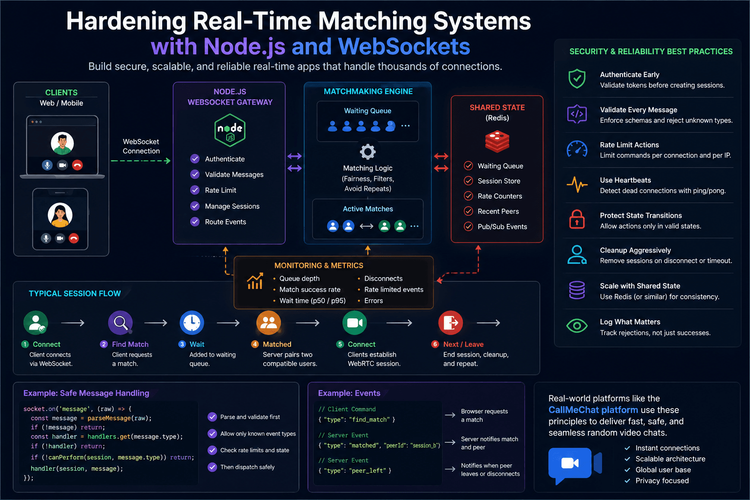
This tutorial explores how to design a safer real-time session gateway in Node.js. The examples use matchmaking because it combines persistent connections, temporary state, rapid user actions, and unpredictable disconnects, but the same architecture applies to multiplayer games, collaborative applications, live-support systems, auctions, presence services, and interactive dashboards.
Begin with a Strict Connection Boundary
A WebSocket connection often starts with something as simple as:
const socket =newWebSocket('wss://example.com/realtime');On the server, the ws package makes accepting connections straightforward:
import{WebSocketServer}from'ws';const wss =newWebSocketServer({port:8080});wss.on('connection',socket=>{console.log('client connected');});That code establishes transport.
It does not establish trust.
After the connection opens, the client could send:
{"type":"find_match"}but it could just as easily send:
{"type":"make_me_admin"}or a 20 MB JSON payload.
Every WebSocket message should therefore be treated exactly like untrusted HTTP input.
SitePoint’s guide to using WebSockets in Node.js for real-time applications discusses the underlying persistent connection model and points out that WebSocket applications still need their own authentication, authorization, validation, and reconnection logic.
A useful architecture begins by placing those controls at the gateway rather than scattering them throughout individual event handlers.
Browser↓WebSocket connection↓Authentication↓Message validation↓Rate controls↓Session state↓Application eventsThe deeper a malformed request gets into the system, the more expensive it becomes to handle.
Give Every Connection a Server-Owned Session
Avoid allowing the client to decide which session it represents.
Instead, create a temporary session when the connection is accepted:
importcryptofrom'node:crypto';const sessions =newMap();functioncreateSession(socket){const session ={id: crypto.randomUUID(),socket,state:'idle',peerId:null,connectedAt:Date.now(),lastActivityAt:Date.now()};sessions.set(session.id, session);return session;}Session IDConnection stateCurrent peerConnection timeLast activityThe browser can be informed of its identifier if necessary:
socket.send(JSON.stringify({type:'session_ready',sessionId: session.id}));But receiving the ID does not make the client authoritative.
{"type":"leave_match","sessionId":"another-session"}the server should ignore the supplied identity and operate on the session already associated with that socket.
functionhandleLeaveMatch(session,message){}This is a small but important design rule:
derive identity from trusted connection state whenever possible rather than asking the client who it is.
Validate Messages Before Dispatching Them
A common WebSocket server pattern is:
socket.on('message',raw=>{const message =JSON.parse(raw);handlers[message.type](session,message);});There are several failure points.
The payload may not be JSON.
message.type may not exist.
The expected properties may have the wrong type.
A string may be enormous.
An attacker may repeatedly send event types the application does not understand.
functionparseMessage(raw){if(raw.length>16_384){returnnull;}let message;try{message =JSON.parse(raw.toString());}catch{returnnull;}if(!message ||typeof message !=='object'||Array.isArray(message)){returnnull;}if(typeof message.type!=='string'){returnnull;}return message;}Then dispatch only known events:
const handlers =newMap([['find_match', handleFindMatch],['next_match', handleNextMatch],['leave_match', handleLeaveMatch],['report_peer', handleReportPeer]]);functiondispatchMessage(session,message){const handler =handlers.get(message.type);if(!handler){return;}handler(session, message);}For larger applications, schema-validation libraries such as Zod can make message contracts more explicit.
constFindMatchMessage= z.object({type: z.literal('find_match'),preferences: z.object({language: z.string().max(8)}).optional()});The advantage is not just security.
Strong message schemas also make frontend/backend contracts easier to maintain.
Authenticate Before Expensive Work Begins
Some real-time applications permit guest sessions.
Others require signed-in users.
Either way, authentication should happen before a socket gets access to expensive application behavior.
One approach is to obtain a short-lived WebSocket ticket through normal HTTPS:
Browser↓POST /api/realtime-ticket↓Authenticated HTTP server↓Short-lived ticketconst socket =newWebSocket(`wss://example.com/realtime?ticket=${ticket}`);The WebSocket server validates the ticket before creating a full session.
A ticket might contain or reference:
User/session IDExpiryAllowed capabilitiesRegionNonceAvoid long-lived credentials in query strings.
A short-lived, single-purpose token limits the damage if it is exposed.
For guest applications, the system may issue a temporary anonymous session token instead of a permanent account credential.
Consumer experiences such as the CallMeChat platform demonstrate why temporary-session architecture matters: users may expect to enter a real-time matching flow quickly, so the backend needs a way to establish safe, short-lived application state without making every interaction depend on a large permanent profile.
The useful engineering pattern is the temporary capability, not the specific interface.
Rate-Limit Actions, Not Just Connections
Traditional rate limiting often focuses on HTTP requests:
100 requests / 15 minutesPersistent WebSockets need another layer.
A client can connect once and then send:
find_matchfind_matchfind_matchfind_match...hundreds of times without opening another HTTP request.
Rate control should therefore apply to individual event types.
A small token bucket can work for local enforcement:
functioncreateBucket({capacity,refillPerSecond}){return{tokens: capacity,capacity,refillPerSecond,updatedAt:Date.now()};}Refill it before each operation:
functionconsumeToken(bucket){const now =Date.now();const elapsed =(now - bucket.updatedAt)/1000;bucket.tokens=Math.min(bucket.capacity,bucket.tokens+elapsed *bucket.refillPerSecond);bucket.updatedAt= now;if(bucket.tokens<1){returnfalse;}bucket.tokens-=1;returntrue;}session.matchBucket=createBucket({capacity:4,refillPerSecond:0.5});functionhandleFindMatch(session){if(!consumeToken(session.matchBucket)){send(session,{type:'rate_limited',action:'find_match'});return;}requestMatch(session);}Different actions deserve different limits.
find_match moderate ratenext_match moderate ratereport_peer low ratetyping_event higher rateprofile_update very low rateSitePoint’s guide to hardening Node.js applications in production covers rate limiting, input validation, secrets, logging, and other production security layers that also apply to real-time services.
Protect State Transitions
Rate limits reduce excessive events, but they do not prevent logically invalid events.
Suppose a session is already waiting:
{state:'waiting'}{"type":"find_match"}again.
Creating another queue entry would be incorrect.
The server should enforce allowed state transitions:
functionhandleFindMatch(session){if(session.state!=='idle'){return;}addToWaitingQueue(session);session.state='waiting';}Similarly, "next_match" should only work when the session is matched:
functionhandleNextMatch(session){if(session.state!=='matched'){return;}transitionToNextMatch(session);}This gives the server an explicit state machine:
idle↓ find_matchwaiting↓ matchedmatched↓ next_matchleaving↓waitingInvalid client events become harmless because they do not satisfy the current state.
The frontend can still have bugs.
The server simply refuses to let those bugs corrupt shared state.
Make Repeated Events Idempotent Where Possible
Networked systems frequently encounter duplicates.
The browser may send "leave_match" and then lose connectivity before receiving confirmation.
After reconnecting, it may try again.
A robust cleanup function should tolerate repeated calls:
functiondetachFromPeer(session){if(!session.peerId){return;}const peer =sessions.get(session.peerId);const oldPeerId =session.peerId;session.peerId=null;if(peer &&peer.peerId=== session.id){peer.peerId=null;}removeActiveMatch(session.id,oldPeerId);}Calling it a second time should not:
Throw an exceptionDelete unrelated stateNotify another peerCreate a negative counterCleanup code is particularly valuable when it is idempotent because many paths may invoke it:
User presses LeaveUser presses NextSocket closesHeartbeat failsModerator terminates sessionServer starts shutdownAll of those are different events describing the same underlying requirement:
the session should no longer own its current match.
The "close" event handles clean disconnections.
But real networks produce half-open connections where the server has not yet realized the client disappeared.
Mobile network changesLaptop sleepWi-Fi failureRouter resetProcess crashThe ws package supports ping/pong frames.
wss.on('connection',socket=>{socket.isAlive=true;socket.on('pong',()=>{socket.isAlive=true;});});const timer =setInterval(()=>{for(const socket of wss.clients){if(socket.isAlive===false){socket.terminate();continue;}socket.isAlive=false;socket.ping();}},30_000);The termination triggers normal cleanup.
Without heartbeat detection, a waiting queue can gradually collect sessions that will never answer.
That creates a particularly confusing failure mode:
Queue appears fullMatches appear availableActual connection success fallsThe problem is not matchmaking.
The state represents clients that no longer exist.
Apply Backpressure Before the Server Is Overloaded
Real-time systems have finite capacity.
Suppose the application can comfortably maintain:
30,000 active WebSockets60,000 connection attemptsAllowing every connection to initialize expensive state may make the service worse for everyone.
Backpressure means deliberately refusing or delaying work when capacity is exhausted.
constMAX_SESSIONS=30_000;wss.on('connection',socket=>{if(sessions.size>=MAX_SESSIONS){socket.close(1013,'Server busy');return;}createSession(socket);});WebSocket close code 1013 indicates that the service is temporarily unavailable and the client may try later.
The service is busy.Trying again shortly...instead of establishing a connection that will perform poorly.
Backpressure can also exist at the queue level.
If a matching region has no realistic capacity:
if(waitingQueue.size>MAX_WAITING){send(session,{type:'capacity_reached',retryAfterMs:5000});return;}Failing predictably is often better than accepting unlimited work and failing unpredictably.
Control Outbound Message Volume Too
Developers often rate-limit incoming messages but ignore server-to-client traffic.
Imagine an operational event that causes the server to broadcast status updates every few milliseconds.
A slow client may not consume messages quickly enough.
The server’s outbound buffer grows.
Check buffered data before continually writing:
functionsafeSend(socket,payload){constMAX_BUFFER=1024*1024;if(socket.bufferedAmount>MAX_BUFFER){returnfalse;}socket.send(JSON.stringify(payload));returntrue;}What should happen when the buffer exceeds the limit depends on the event.
For transient presence information, dropping an old update may be acceptable.
For a critical state transition, you may need to disconnect the slow client and let it resynchronize.
This distinction leads to an important real-time design question:
Does every event need guaranteed delivery?
Often the answer is no.
typing indicator disposablequeue count replaceablecurrent state importantmatch created importantpermission revoked importantClassifying events prevents the application from treating every message as equally expensive.
Separate Commands From Events
Clear terminology can improve server architecture.
A command asks the application to do something:
find_matchleave_matchreport_peerAn event tells the client something happened:
match_createdpeer_leftreport_receivedBrowser → ServerServer → BrowserThis makes server authority easier to reason about.
Avoid letting the client send "match_created".
The client cannot create authoritative matches.
{type:'find_match'}is accepted as a command.
Then the server eventually emits:
{type:'match_created',matchId:'match_381',peerSessionId:'session_b'}This naming convention is not mandatory, but it helps reveal which side is allowed to decide state.
Avoid Broadcasting More Information Than Necessary
A real-time server can easily become a privacy boundary.
{id,region,language,ipAddress,connectedAt,moderationFlags}The matched peer probably does not need all of that.
Create deliberate public payloads:
functionbuildPeerPayload(peer){return{sessionId: peer.id,language:peer.preferences.language};}send(session,{type:'matched',peer});That couples an internal server object to a public protocol.
As internal fields are added later, they may accidentally become exposed.
This is the real-time equivalent of returning a complete database row from an HTTP API.
Build protocol objects deliberately.
Treat Reporting as a Server Workflow
A report button is easy to render:
<buttonid="report">Report</button>The important part happens after it is clicked.
socket.send(JSON.stringify({type:'report_peer',reason:'inappropriate_behavior'}));Notice that the browser does not need to specify which peer is being reported.
The server already knows the current match:
functionhandleReport(session,message){if(session.state!=='matched'){return;}const reportedPeerId =session.peerId;createModerationEvent({reporterSessionId:session.id,reportedSessionId:reportedPeerId,reason:normalizeReason(message.reason),timestamp:Date.now()});}This prevents the client from reporting arbitrary session IDs.
The principle applies beyond reporting.
Whenever the server already possesses the relationship, do not ask the browser to recreate it.
Use Cooldowns for Expensive Actions
Some operations are too expensive to allow continuously even if they fall below a generic message rate.
For example, creating a new match may require:
Candidate searchShared datastore accessCross-server coordinationNotificationsModeration checksIntroduce an action-specific cooldown:
functioncanRematch(session){const now =Date.now();const elapsed =now -(session.lastRematchAt||0);if(elapsed <750){returnfalse;}session.lastRematchAt= now;returntrue;}The server can silently ignore too-fast requests or communicate the delay.
The client should also disable controls during the transition:
nextButton.disabled=true;but remember the trust boundary:
Frontend prevention → user experienceBackend prevention → system integrityBoth are useful.
Only the second one is authoritative.
Handle Reconnection as a New Question
When a WebSocket drops, the browser may reconnect automatically.
Do not automatically assume the previous server state remains valid.
Did the old session expire?Is the previous match still active?Did the peer already leave?Should the user re-enter the queue?Can state be resumed safely?For an intentionally ephemeral matching system, the simplest and safest policy may be:
Disconnected socket↓Destroy temporary session↓Reconnect↓Create new temporary sessionFor a collaborative editor or game, full session resumption may be necessary.
Those applications need a stronger reconnect protocol.
The point is to choose explicitly.
Do not let reconnection behavior emerge accidentally from whatever objects happen to remain in memory.
Move Counters Out of Process When You Scale
A local rate limiter works on one Node.js instance.
Now place three instances behind a load balancer:
Load balancer/ | Node A Node B Node CIf a client can reconnect to different servers, process-local counters may reset.
Likewise, each server may have an incomplete view of:
Active sessionsReportsConnection attemptsQueue sizeAt that point, some state needs shared coordination.
A distributed datastore can maintain:
Rate-limit countersTemporary session metadataQueue membershipModeration cooldownsCross-server presenceRedis is a common choice because it provides expiring keys, atomic operations, sets, sorted sets, and pub/sub mechanisms.
A distributed rate-limit key might look like:
realtime:rate:203.0.113.10with a short expiration.
The broader architecture becomes:
Browser↓Node WebSocket server↓Shared real-time state↓Other Node instancesOnce the service scales horizontally, process memory should be treated as a cache of what that process owns—not automatically as the authoritative view of the entire system.
Instrument Rejections, Not Just Successes
connection openedmatch createdconnection closedbut ignore rejected operations.
Those rejections often reveal system health earlier.
Invalid messagesUnknown event typesRate-limited commandsRejected state transitionsHeartbeat timeoutsOutbound-buffer overflowsCapacity rejectionsReconnect frequencymetrics.increment('realtime.command.rejected',{reason:'invalid_state',command: message.type});Suppose a new frontend release suddenly increases:
invalid_state +400%That could indicate a client race condition.
heartbeat_timeoutmight point to a regional networking issue.
Operational observability should cover the rules protecting the system, not just the work that succeeds.
Log Identifiers, Not Conversation Contents
Real-time systems can produce extremely sensitive logs if developers are careless.
console.log(message);for every incoming event.
Messages may eventually include:
Text chatUser-entered profile dataTokensModeration detailsPrivate metadataPrefer structured operational logs:
logger.info('realtime.command',{sessionId:session.id,type:message.type,state:session.state});logger.info('match.created',{matchId,sessionA:sessionA.id,sessionB:sessionB.id,waitMsA,waitMsB});The goal is to reconstruct application behavior without unnecessarily storing user content.
Test Hostile Sequences, Not Just Valid Ones
A traditional integration test might verify:
User A waitsUser B joinsMatch is createdThat confirms the happy path.
A real-time gateway needs adversarial and failure-oriented tests too.
Client sends malformed JSONClient sends 1,000 commands rapidlyClient presses Next twiceClient reports while unmatchedClient disconnects during pairingClient reconnects immediatelyClient stops answering heartbeat pingsSlow client accumulates outbound messagesTwo server instances try to mutate shared stateA concurrency test could send duplicate commands:
awaitPromise.all([sendCommand(session,'next_match'),sendCommand(session,'next_match')]);expect(countNewMatches(session.id)).toBe(1);for(let i =0;i <100;i++){sendCommand(session,'find_match');}expect(metrics.rateLimited).toBeGreaterThan(0);Real-time applications fail in sequences.
Test sequences.
Keep the Gateway Small
One of the easiest architectural mistakes is turning the WebSocket server into the entire application.
Avoid creating one enormous handler responsible for:
AuthenticationMatchmakingModerationDatabase queriesWebRTC signalingBillingNotificationsAnalyticsUser profilesAccept connectionAuthenticate sessionValidate commandApply rate controlsRoute commandSend eventTrack lifecycleBusiness operations can live behind service boundaries:
await matchmaking.requestMatch(session.id);await moderation.report({reporterId:session.id,peerId:session.peerId,reason});This makes the WebSocket layer easier to test and lets other transports reuse the same business logic later.
The same matchmaking service could eventually serve:
WebSocket clientsMobile gatewayAdministrative toolingAutomated testing clientswithout duplicating its internal rules.
Design for the Connection You Will Eventually Lose
Persistent connections create an illusion of continuity.
A browser is connected now, so it feels natural to assume it will remain connected.
It won’t.
Every connection eventually closes.
A robust real-time design therefore starts with different assumptions:
Every message is untrusted.Every action may be repeated.Every client may disappear.Every external dependency may slow down.Every server has finite capacity.Every local process may eventually restart.Those assumptions produce better architecture.
Sessions become temporary.
Cleanup becomes idempotent.
State transitions become explicit.
Rate limits exist around expensive commands.
Heartbeat failures become expected.
Shared state is introduced when horizontal scaling requires it.
And monitoring includes the operations the system rejects as well as those it accepts.
Conclusion
Opening a WebSocket is the easy part of building a real-time application.
Operating thousands of long-lived, user-controlled connections safely requires a stronger boundary around the transport.
Create server-owned sessions. Validate messages before dispatching them. Limit actions inside the persistent connection instead of relying only on HTTP rate limits. Protect state transitions so duplicate commands cannot corrupt shared state. Detect dead clients with heartbeats and remove their re
As the service scales, introduce backpressure rather than accepting unlimited work, move globally authoritative counters into shared infrastructure, and make distributed mutations atomic where necessary.
Most importantly, keep the WebSocket gateway small.
Its job is to turn an untrusted stream of client commands into validated application operations and controlled server events.
When that boundary is explicit, real-time features become easier to reason about—and considerably harder for accidental bugs or hostile traffic to destabilize.
