



Community Article
Community articles are authored by SitePoint Premium contributors. Content is screened before publication, and SitePoint reserves the right to moderate or remove articles that violate our guidelines. Views expressed are those of the authors and do not necessarily reflect those of SitePoint.
**Data-Driven vs Event-Driven Architecture: How to Pick the Right One**
TechPandaPublished inDesign·
September 19, 2026
·Updated:September 19, 2026
The AI briefing for Developers
Stay up to date with AI tools, model releases, and developer workflows that matter.
Weekly. Free. One click to leave.
SitePoint Premium
Stay Relevant and Grow Your Career in Tech
- Premium Results
- Publish articles on SitePoint
- Daily curated jobs
- Learning Paths
- Discounts to dev tools
7 Day Free Trial. Cancel Anytime.
Every developer hits this moment. You are sketching a new system on a whiteboard, and someone asks, “Should this be data-driven or event-driven?” Half the room nods. The other half quietly opens a search tab.
The two terms sound similar, but they answer different questions. One asks, “What data do we have, and how do we use it?” The other asks, “What just happened, and who needs to know?”
Let’s break both down in plain language, compare them, and work out when each one makes sense.
What Is Data-Driven Architecture?
In a data-driven architecture, data sits at the center of everything. The system is built around collecting, storing, and using data. Services, reports, and features all revolve around a sharedke
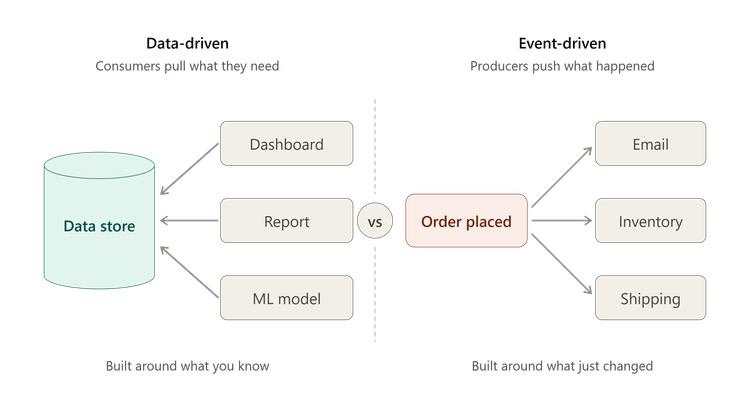
Think of a public library. All the books (your data) live in one place. Anyone who needs something walks in, finds it, and reads it. The library doesn’t chase you down the street to hand you a book. You come to it when you need it.
A typical data-driven setup looks like this:
Data is collected from apps, users, sensors, or third-party tools.
It is stored in a central place.
Other parts of the system query that data when they need it.
Decisions, dashboards, and features are built from what the data says.
Examples include a sales dashboard that pulls numbers every morning, a recommendation engine trained on months of past purchases, or a reporting tool that runs a nightly job to crunch the day’s orders.
The key idea is that data drives decisions. The system is only as smart as the information it holds.
What Is Event-Driven Architecture?
Event-driven architecture (EDA) is built around things that happen. An event is a small message that says, “This just occurred.” A user placed an order. A payment failed. A sensor crossed a temperature limit.
When an event happens, the part of the system that noticed it (the producer) sends it out. Other parts (the consumers) listen for events they care about and react on their own. The producer doesn’t need to know who is listening.
Think of a fire alarm in an office building. When smoke is detected, the alarm goes off. Nobody has to walk floor to floor knocking on doors. People hear it and respond in their own ways. Some evacuate, some call the fire department, and the elevators lock down. The alarm doesn’t care who reacts or how.
In software, this usually involves a few pieces:
Producers create events.
A broker or event bus (like Kafka, RabbitMQ, or AWS EventBridge) carries them.
Consumers pick up events and do something in response.
For example, when a customer places an order, an “OrderPlaced” event goes out. The inventory service reduces stock, the email service sends a receipt, the shipping service prepares a label, and the analytics service records the sale. None of them talks directly to the order service.
The Core Difference in One Sentence
Data-driven architecture is organized around what you know. Event-driven architecture is organized around what just happened.
One is about state, the current picture of things. The other is about change, the moment something shifts.
A Side-by-Side Look
How things get triggered. In a data-driven system, work is often pulled. A service asks for data when it needs it, or a scheduled job runs at set times. In an event-driven system, work is pushed. Something happens and everyone interested is notified right away.
Speed of reaction. Event-driven systems respond in near real time. Data-driven systems can be real time too, but many rely on batches, refreshes, or polling, so there is often a delay.
How tightly things are connected. Event-driven systems are loosely coupled. Services don’t need to know about each other, only about the events. Data-driven systems often share a database or data model, which can tie teams and services together more closely.
Where the “truth” lives. In data-driven design, the truth is the stored data. In event-driven design, the truth can be the stream of events itself. Some teams even rebuild the current state by replaying old events, a pattern called event sourcing.
Complexity. Data-driven systems are usually easier to understand and debug at the start. Event-driven systems bring extra moving parts, like brokers, retries, and ordering, which take more effort to get right.
When Data-Driven Architecture Shines
Data-driven design is a great fit when your main goal is to learn from information or make smart decisions over time.
Analytics and reporting. If you are building dashboards, business intelligence tools, or monthly reports, you need a solid, well-organized store of data. Speed to the millisecond usually isn’t the priority. Accuracy and depth are.
Machine learning and AI. Models learn from historical data. The more clean, relevant data you have, the better they perform. Here, data is the raw material of the whole product.
Personalization. Recommending products, tailoring content, or adjusting prices based on user behavior all depend on rich data about past actions.
Simple applications. A small app with a database and a few screens doesn’t need a fleet of message brokers. A straightforward data-centered design keeps things easy to build and maintain.
Compliance and auditing. When you need one clear, trusted record of what is true, a central data store makes life easier.
When Event-Driven Architecture Shines
Event-driven design is the better choice when timing matters and many things need to react to the same happening.
Real-time features. Live notifications, chat apps, ride tracking, stock tickers, and fraud alerts all need to respond the moment something occurs. Waiting for a nightly job would defeat the purpose.
Microservices. When teams own separate services, events let those services work together without being glued to each other. One team can add a new consumer without touching the producer’s code.
Scaling unevenly. Different parts of a system often face different loads. With events, each consumer can scale on its own. A busy email service doesn’t slow down checkout.
Workflows with many steps. Placing an order can trigger payment, stock updates, shipping, and messages. Events let each step happen independently, and failures can be retried without blocking everything.
Connecting many systems. If you need to sync data across apps, partners, or older tools, events give you a clean way to broadcast changes.
The Trade-Offs Nobody Puts in the Brochure
Both approaches have downsides, and it is better to know them early.
Challenges with data-driven design:
Shared databases can become bottlenecks as traffic grows.
Data can go stale if it only refreshes on a schedule.
Changing a data structure can break many things at once.
Poor data quality leads to poor decisions, and it takes discipline to keep data clean.
Challenges with event-driven design:
Debugging is harder. When something breaks, you have to trace a chain of events across many services.
Events can arrive late, twice, or out of order, so your code has to handle that.
Eventual consistency means different parts of the system may briefly disagree about the current state.
You need to manage event formats over time. Change an event carelessly and you may break every consumer.
The team needs to learn new tools and habits.
There is no free lunch. Event-driven gives you flexibility and speed, and you pay for it with complexity. Data-driven gives you simplicity and clarity, and you may pay with rigidity and delay.
They Are Not Enemies
Here is the part many articles skip. In real projects, you rarely choose one and throw the other away. The two ideas work well together.
Picture an online store. When a customer buys something, an event fires, so inventory, email, and shipping react instantly. That’s event-driven. The same events also flow into a data warehouse, where analysts study buying patterns and a model learns to recommend products. That’s data-driven.
Events are one of the best ways to feed a data platform. Instead of copying data in big nightly batches, you stream changes as they happen. The data stays fresh, and your analytics get better. Many modern companies run exactly this way: events for action, data for insight.
How to Choose: A Few Practical Questions
If you are stuck, try asking yourself these questions.
Does something need to happen right now when an action occurs? If yes, lean toward events.
Is the main goal to analyze, report, or learn from information? If yes, lean toward a data-driven design.
How many systems need to react to the same change? If the answer is “several, and growing,” events will save you pain later.
How big and experienced is your team? A small team building a first version is often better off keeping things simple. You can add events later, when the need is real.
What happens if data is a little late? If a five-minute delay is fine, batches and queries will do. If it’s not fine, think events.
How will you find and fix problems? If you don’t have good logging and monitoring, an event-driven system can turn into a guessing game.
A Quick Word on Starting Small
A common mistake is adopting event-driven architecture because it sounds modern. Teams add a message broker, split everything into tiny services, and end up with a system that is hard to run and harder to explain.
Start with the problem. If a simple database and a few API calls solve it, that’s a perfectly good architecture. When you feel real pain, such as slow responses from chained calls, services tangled together, or a need for instant reactions, introduce events in the specific places they help. You don’t have to rebuild everything.
Likewise, don’t ignore data just because events feel exciting. Even the most event-heavy system needs solid data storage, clear models, and good quality control. Events tell you what happened, but data tells you what it means.
Final Thoughts
Data-driven and event-driven architectures aren’t rivals. They are two lenses for looking at the same system. One asks what you know, and the other asks what just changed.
Use a data-driven approach when insight, analysis, and a reliablehen speed, flexibility, and independent services matter most. And when your system grows, expect to blend both
The best architecture isn’t the trendiest one. It’s the one your team can build, understand, and run without losing sleep. Start with your real needs, stay honest about the trade-offs, and let the design grow as the problem does.
